Showing posts with label people i love. Show all posts

Sunday, May 09, 2010

so. it's mother's day.

mother's day was never really one of my favorite days. in my family, it always played very well into that well-established pattern of putting on a unified "Big Happy Family" front, trying to make invisible the million dysfunctions that made our family not at all happy. and it played well into the often-enforced "mother is always right" rule. and the "feel bad for your mother because she does so much and is such a martyr for this family" meme.

and so i would always buy a stupid little sappy card from hallmark and pretend like we fit into that image of the family whose emotions are perfectly expressed by lovey-dovey Hallmark cards. or i would buy a snarky card, the kind that walks the line between mean and loving, and pretend that i could honestly sit on the "loving" side of that line. and yeah, sometimes i meant it, and sometimes i could identify with the "love your mother" sentiments in these lame cards. but more often than not, mother's day was just another opportunity to fake our way as that happy loving family that my parents wanted so badly.


once i was at college and far enough away from that family system to see how dysfunctional it really was, mother's day made me bitter. i was bitter that i still felt obligated to buy these cards that i clearly didn't mean, and i was bitter that i had to call my mom on mother's day and pretend that she deserved the honor that this day was set aside for. i was bitter that i'd tried to turn so many women into maternal figures over the years (i believe i was at about 15 or so at last count), and none of them had completely filled that void, and none of them had wanted to, and i probably couldn't have let them fill that void anyway. most of all, though, i was bitter at all the truly loving moms and daughters i saw around me, because it felt like a slap in the face. sure, i was happy for them, and i was glad that there were women around who had the capacity to be that truly "good mother" (read: able to love without narcissism/martyrdom), but i was bitter, and it made me feel cheated, and it made me feel sorry for myself. i hated feeling all of these things, which made me hate mother's day even more.

eventually, i started to open my eyes. by which i mean, i started to open my heart. all of the love that i saw around me between loving mothers and daughters felt more like warmth and less like a slap in the face. i stopped forcing myself to send my mother cards that had sentiments i didn't mean. one year, i just sent her a pretty card that said "happy mother's day" on the inside. that's it. i don't think i even signed it "love, jen." just "-Jen." the next year, i sent her nothing, and the next week, i cut her and my dad out of my life entirely. (she likes to tell the story that she got that letter on mother's day, that i planned it like that to hurt her. too bad mother's day is on a sunday, the postal service doesn't deliver on sundays, and i didn't put the letter in the mail until after mother's day. oh, drama queens.)
on one of those mother's days, instead of seeing what i never had growing up, i saw the mothers who i admired, and i saw the women who had mothered me in some way or another. i saw them for the love that they held, and i could honor them for that, without (ok, with only a little) bitterness.
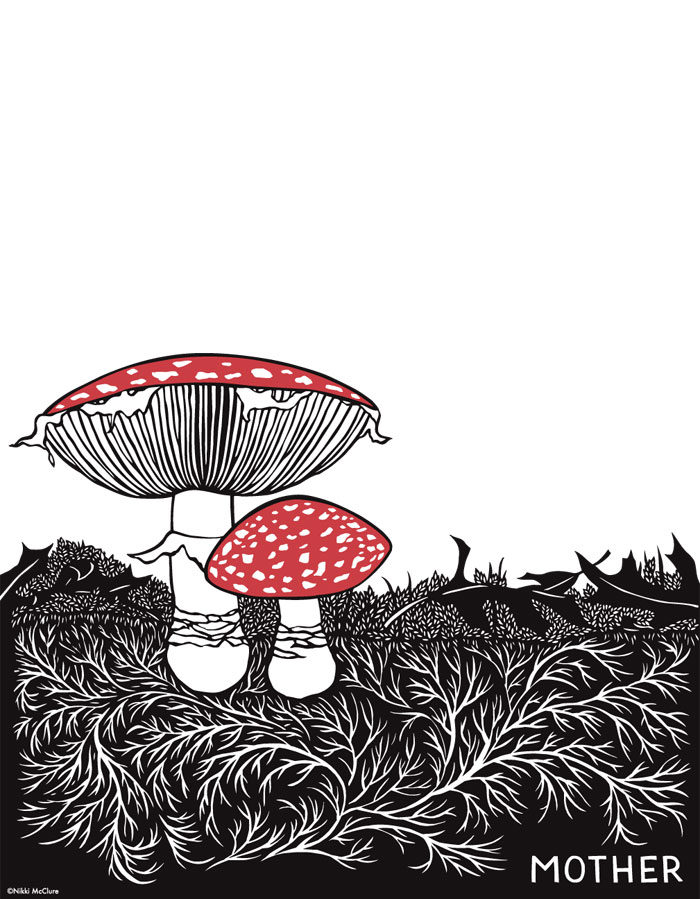

(image: Nikki McClure, an artist in washington state.
i adore her work. you should go buy some of it.
no, really, you should. or, alternatively,
buy a print for me. you can do that here.)

this mother's day, i felt surprisingly little bitterness and sadness over the mother i didn't get from biology. i felt absolutely no guilt about not sending her a mother's day card, and only a little lingering guilt over estranging myself from my parents (that's guilt that i don't expect to ever completely go away).
this mother's day, i was able to fully embrace the fierce love i feel for the amazing mothers in my life. primarily, the mothers i've chosen to be part of my life, but also the amazing feminist, loving mamas i see around me all the time. not all of these women have had children, but that's the thing about the women i honor on mother's day: biology only sometimes correlates with great motherhood.

the two women who've taught me what maternal love looks like, who've filled my heart with that love: not anywhere close to biologically related. we don't even share a common ethnicity (they're both very white. me, not so much).
the two other women who took me in when i was a "stray" have stepped into some role between big sister and mom, who joke that they have to share custody with the former two women: neither has ever given birth or even (to my knowledge) been pregnant. they're only 6 and 7 (or 8?) years older than me. because you don't have to be related to someone to be a mother. and you don't have to give birth to know how to be a mother.
motherhood is so, so, so much more than pushing a kid out of your uterus. and maternal love comes in more forms than bio-mother/bio-child. i am so thankful for that.


so, today, i'm not bitter or angry about mother's day. i'm beyond grateful for the luck/fate that brought these women into my life and made my heart more full than i ever thought possible. and i am quietly rejoicing every time i see a woman who is or will be a great mother to someone who needs it, in whatever form that takes.


happy mother's day.

Friday, October 16, 2009

how to write about rape & sexual abuse

But first:

How NOT To Write About Rape & Sexual Abuse
I'm sure that with a simple overview of my internet history from the past couple weeks, I could come up with a list of about 50 articles from mainstream media sources that exemplify the utter failure of most journalists to accurately and sensitively write about issues of rape, sexual abuse, and sexual violence.

I don't have the time or the patience to compile that list, though, so I'll just stick with the one that most infuriated me.
This story is also local to Kansas City, as is the better one I'll highlight below.

On October 11, the Kansas City Star printed a story from NY Times writer Michael Cieply. The KC Star version wasn't published online, but it was an abbreviated version of the full article, published on the NYT website here.
Surprisingly enough, the full version is actually slightly less offensive than the abbreviated version that the KC Star published. They left out some of the (still problematic) nuance that Cieply provided, giving a vomit-inducing, unmistakable narrative of "gee darn, no more sex with the young'uns! Weren't the good old days grand?"
For proof, I give you this picture of the headline subtitle that I took with my phone, as seen in the print version of the Star on Sunday, Oct 11th:


I hate how often I need to say this, but it seems to bear repeating. Again.
Rape. Is. Not. Sex.
Polanski did not "have sex" with the victim. Even the article itself includes this line (though it's mentioned & not addressed again): "...even while acknowledging that the victim [name redacted] had offered grand jury testimony of forcible rape."
Cieply's article was bad enough in its original form.
And somehow, the KC Star managed to take a terrible article and make it even more offensive.


Now, I get to the better part. A publication that is responsible AND responsive. This is also partially a story of how much I love Twitter.

How To Write About Rape & Sexual Abuse
On Thursday, Oct 15th, the Pitch Plog's Twitter feed (pulled directly from their postings) showed this:


Whoa.
Fail.
I was pretty sure that "child sex" was a misnomer, so I followed the link (the pic above is linked to the tweet pictured). Sure enough, the article that followed the misleading headline was in fact about a child sexual abuse case. The copy of the article was actually pretty well-done - factual and to the point, without any offensive mentions of "sex" with children.
I expected better from the Pitch, which is one of KC's local more alt-news papers. They're generally pretty liberal and responsible when they cover serious issues like this.


So, in a display of what I was pretty sure was naïveté, I sent this reply tweet to the Pitch:


And here's the part where I love the immediacy of Twitter.
Within a couple of hours, the headline had been corrected, and read as follows:
Settlement reached in child sex abuse case naming former KC bishop
Yes!
Thank you, Pitch. (And yes, I thanked them on Twitter, too.)
I wish all media sources were as responsive when it came to journalistic sensitivity and responsibility around sexual violence.

Oh, and I received this lovely direct message from @pitchplog on Thursday night:


There you have it.
It IS possible to get it right, and to admit when you've been wrong.
Well done, Pitch.
(Disappointed, KC Star.)

Friday, October 09, 2009

quick hit: rape culture 101

So much has been said lately in the media about sexual abuse.
Unsurprisingly, the media has more often than not been pretty awful in their reporting. (See, for a quick example, MSNBC's story on Tyler Perry's revelations of childhood physical, sexual, and emotional abuse in which they describe his abuse as being "seduced" by a friend's mother at age 10. Yes. "Seduced." MSNBC: You cannot seduce a 10-year-old.)

There's a lot I could write about, from Mackenzie Phillips' memoir that reveals the drug- and alcohol-fueled sexual abuse by her father to Tyler Perry's recent revelations of childhood abuse to the debacle with Roman Polanski finally being (re-)arrested for the rape he committed 30-some-odd years ago.

But I won't, for now.
I don't have the emotional and mental space to hold all of that today. It's been a tough week.

Instead, I implore you to read Liss' post over at Shakesville. Read it. This is not one that you should pass over. This is one that every person who interacts with any other human being needs to read.

Rape Culture 101.

A long-ish teaser:

Rape culture is 1 in 33 men being sexually assaulted in their lifetimes. Rape culture is encouraging men to use the language of rape to establish dominance over one another ("I'll make you my bitch"). Rape culture is making rape a ubiquitous part of male-exclusive bonding. Rape culture is ignoring the cavernous need for men's prison reform in part because the threat of being raped in prison is considered an acceptable deterrent to committing crime, and the threat only works if actual men are actually being raped.

Rape culture is 1 in 6 women being sexually assaulted in their lifetimes. Rape culture is not even talking about the reality that many women are sexually assaulted multiple times in their lives. Rape culture is the way in which the constant threat of sexual assault affects women's daily movements. Rape culture is telling girls and women to be careful about what you wear, how you wear it, how you carry yourself, where you walk, when you walk there, with whom you walk, whom you trust, what you do, where you do it, with whom you do it, what you drink, how much you drink, whether you make eye contact, if you're alone, if you're with a stranger, if you're in a group, if you're in a group of strangers, if it's dark, if the area is unfamiliar, if you're carrying something, how you carry it, what kind of shoes you're wearing in case you have to run, what kind of purse you carry, what jewelry you wear, what time it is, what street it is, what environment it is, how many people you sleep with, what kind of people you sleep with, who your friends are, to whom you give your number, who's around when the delivery guy comes, to get an apartment where you can see who's at the door before they can see you, to check before you open the door to the delivery guy, to own a dog or a dog-sound-making machine, to get a roommate, to take self-defense, to always be alert always pay attention always watch your back always be aware of your surroundings and never let your guard down for a moment lest you be sexually assaulted and if you are and didn't follow all the rules it's your fault.

Saturday, August 22, 2009

Young Feminists VS. Older Feminists? Or Young Feminists WITH Older Feminists?

2nd wave vs 3rd wave.
Old biddies vs young visionaries.
Wise women vs ungrateful little girls.
Maybe even: mother vs daughter.
"This is not your mother's feminism."
"Young women don't know what feminism is."

We've heard all of these before, from each side, staking out their territory in generational wars. This is nothing new. Feminism has been declared dead over and over, sometimes even by older women who've dedicated their lives to a feminism that no longer exists in the way they knew it.

I come to this...debate? disagreement? full-out fight?...as one of those supposedly ungrateful, lazy, selfish young feminists. I'll admit that I get awfully sick of the older generation disparaging my entire peer group, condescending to us, not trusting us, and refusing to pass on that torch.
But I do understand where a lot of the distrust comes from. I'll also admit that I do have peers who don't value the wisdom of the older generation, who don't want to be passed the torch so much as either rip the torch from the older feminists' hands or try to reinvent fire altogether.

This older generation of feminists that so distrusts my generation has been through a hell of a lot. They've had to fight like hell so that we don't have to fight quite so hard for the same things. Most of them were around when abortion was illegal, and know firsthand what exactly we'll lose if Roe falls. A lot of them were trailblazers in their field, entering predominantly male workforces and facing intense, overt discrimination. They might have been getting married when spousal rape was still perfectly legal. They've got stories to tell and wisdom to share. And yes, there are some in my generation who don't really care, but really: most of us do care.
It's a respect thing, but it's also just a logical strategic thing: if there's wisdom there, learn it. You don't need to reinvent the wheel.


This generation gap / fight / debate / disagreement / whatever is a little tiresome. For everyone. When we waste our energy fighting with each other over who gets to carry the torch, we sacrifice our ability to blaze any trails.

This is why I'm super stoked to be going to this conference at the Omega Institute in a few weeks:

Women & Power: Connecting Across the Generations. (video will automatically start playing)

The Women’s Institute at Omega is breaking new ground and bringing women of different generations together for one electrifying weekend. Featuring more than 34 amazing trailblazers, Women & Power: Connecting Across the Generations will get you charged up to make a difference in your life, your home, your community, and the world.

Join us for a weekend of celebration, uplifting speeches, entertainment, and panel discussions with women from different backgrounds and generations. Award-winning novelist Isabel Allende; Alberta Nells, youth leader of the Navajo Nation: feminist icon Gloria Steinem; singer/songwriter Natalie Merchant; and playwright, poet, activist, solo-performer, Sarah Jones; are just a few of the diverse women coming together to share, unite, and inspire.


It's got a pretty rockstar list of faculty:
Isabel Allende
Lori Barra
Maya Breuer
Cathy Collins
Ann Friedman
Carla Goldstein
Angela Hucles
Charreah Jackson
Sarah Jones
Jensine Larsen
Andrea Lee
Elizabeth Lesser
Jana Long
Donna Lopiano
Courtney Martin
Jessica Mendoza
Natalie Merchant
Pat Mitchell
Elisa Mott
Samhita Mukohopadhyay
Alberta Nells
Ana Nogales
Sarah Peter
Adrienne Ressler
Eliza Reynolds
Sil Reynolds
Lateefah Simon
Gloria Steinem
Gail Straub
Helen Thomas
Jessica Valenti
Vanessa Valenti
Sakena Yacoobi
Miriam Zolia Perez


Yeah.
My homegirl Gloria Steinem will be there!
And OMG. Helen Thomas. I have such a grandma-crush on her. (i.e. I would like for her to be my grandmother)
And Isabel Allende!
And and and and and...
I'm stoked.

Friday, July 17, 2009

Mapping Our Stories

I absolutely love this idea and this project.

Ariel, a guest blogger at Feministe, came up with this great idea. Using Google Maps, she is having Feministe readers map all of the places where we feel strong on a collaborative google map. A collective geography of strength.

I love that.

It's already getting pretty well filled in, and she's had the post up for less than a day.

Check out the map here.


As with most new Google technologies and tricks and widgets and whatnot, now I really want to incorporate this into the rest of my life. (I've already hooked most of my coworkers on Google docs.) Google really is made of genius. Most days, I wish I were much geekier and knew more about computers so that I could go work at that Google castle in the sky...or wherever their HQ is at.

I think I want to map my story.
Ooh! I could also map the history of reproductive rights & reproductive justice in the US.
And, and...oh, the possibilities are endless.....


I may or may not post the link of my mapped out story. Working in repro justice in the midwest, so close to where Dr. Tiller was killed, I worry about what will make me even more identifiable and easier to target. (aside: how fucked up is it that I have to worry about these things??)

Either way, I fully support this kind of self-reflective geekery, and I'd encourage anyone to map their story like this.

Sunday, April 19, 2009

filling voids and finding love (and so on)

a new blog i've been reading on a relatively regular basis: Blooming Lotus. faith is using this blog to document her process of healing from child abuse, and while it's sometimes a little painful to read, it's comforting in the familiarity of the content. and the places that i still can't talk about (despite the hypocrisy of my dedication to speaking the unspeakable), faith goes there. she talks about it. and for that, i am thankful and in awe.


recently, faith posted about searching for something to fill that void of being motherless. not "motherless" in the straightforward sense; faith had a woman to call 'mother,' as did the commenter who inspired this post. "motherless" in the sense that neither of these women's mothers acted motherly. neither of these women's mothers fulfilled that role. and so, both of these women have huge, gaping holes in their hearts where a mother's love should be.
it's incredibly sad to see someone with such a void.
it's incredibly painful to feel that camaraderie.


faith's post is specifically about trying to fill that void, and is something of a follow-up to this post, about wishing for another mother.
a mother do-over, if you will.

familiar? that's an understatement.


i've searched for a mother figure in my life for almost as long as i can remember. i wrote a story when i was in 2nd grade about my teacher, Mrs. Osmon, adopting me and taking me away from my family to live a better, happier life. i was 7 years old. (i'd also recently read Matilda, which may have had an impact on the mother figures i sought out. thanks, Roald Dahl.)
i went from Mrs Osmon to Miss Clark, my 4th grade teacher. from there, i clung to other teachers, always female, always with a maternal, loving air about them. it went on through high school and into college. i gave up on searching for that maternal figure for a year in college, when i'd given up on pretty much everything else. ...and then i went back to yearning for it.

for all my efforts and all the different maternal figures i'd tried to latch onto, none of them stuck. not one of the 26 or so women - teachers, coaches, professors, deans - i'd hoped to make into my 2nd mother stuck around. most of them, i pushed away, consciously or unconsciously. most of them, too, i pushed and pulled and pushed and pulled until they had to step away. what i thought i needed was someone to take care of me, to hold all of the wounded little parts for me. what i was really hoping for was someone to do the work for me, to mother me without the expectation that i'd do it for myself.
and maybe, if i'd been able to voice it or really ask for it, i could've gotten that when i first started looking for it at age 7 or 8. but by the time i was in high school and college, i needed to be adult enough to take care of myself...i didn't want to. and so i hoped and expected that these caring females that i clung to would take care of me for me.


long story short, in the middle of a huge storm of intense healing (and pain), i realized, in my heart, that i needed to take care of myself. that i needed to be my own mother. that i needed to take responsibility for myself and stop trying to make other maternal figures take responsibility for me.

i attribute this to an incredible twist of fate, or the timely return of karma, or something of some power well beyond my own: almost immediately after realizing and accepting that fact, i found that mother figure i'd always wanted and needed.
...in my boss, of all people.

she didn't take care of me in an unhealthy caretaking way, but she did (and does) nurture me and love me in exactly the way that i'd always craved. she sat with me through some of the worst memories, she made me laugh exactly when i needed to, she forced me to take responsibility for myself when i didn't want to, she let me nap on her couch in her house when i needed to be away from my roommates, she even drove with me halfway across the country when i moved away from new england. her amazing family, too, let me in and i came to love them as well, and i got to see what a real, loving family is like.

it feels like i've known her forever, but really, i've only known her for a little over a year and a half. in that year and a half, our relationship has evolved from employer to sorta-friend to mother to what it is now. i can't really explain it, but it's somewhere between and within maternal and one of the best friends i've ever had.


so, yeah. i have managed, somehow, to fill that void. at least, to fill it as much as it's going to be filled. there'll always be an empty spot where the woman who raised me should've been, and i grieve for that loss. but the rest of that emptiness, the vast expanse that needed to be filled with love? it's full. overflowing, sometimes, even.


i don't pretend this was anything i could've willed to happen. it happened because i got lucky, because the fates aligned, because whatever good karma i'd stocked up all came back in a rush, because some higher power allowed it to happen. and every time i talk to H or her wife or her kids, i feel that luck/karma/fate/higher power, and every time, i'm in awe of how incredible it feels to be a lot more loved and a little more complete.

Friday, April 03, 2009

sad, and true, and real

Melissa just posted "The Survivor Thread."


i maintain my linguistic issue with the term "survivor," because of the capital-S Survivor Story it implies, but in this case, i'm ok with using it.

because this thread over at Shakesville isn't about that mainstream idea about what survivors should look like and act like and be. this thread is about reality.

specifically, this reality:
And many of us who are survivors of repeat assaults will not speak of it; many of us will pick the "worst" one and talk about that in threads on assault, as if it's the only one. We do this for many reasons: We might feel embarrassed by being repeatedly victimized, as if it's indicative of a character flaw within ourselves; we might have trouble discussing multiple assaults without undermining what tenuous feeling of safety we have; we might have faced reactions of incredulity from people with whom we shared this information and thought we could trust; we might have been called liars or hysterics—accusations born of the silence about sexual assault.

Disbelief is the inevitable result of swimming in a culture which renders invisible the reality that enormous numbers of women—and men—have been sexually assaulted, many of them more than once.


as of the writing of this, her thread has been up for about 12 hours.
there are currently about 225 comments.
so many stories, so many stories within stories in conjunction with other stories.

it's powerful, and sad, and i don't know if i'll ever be able to read all of the stories in those 225 comments.
it's also true, and real, and for that reason, you really should go read it. if not all of it, at least part of it.
really.
go read it.

Sunday, March 01, 2009

poems for survival

A Litany for Survival
Audre Lorde (in The Black Unicorn)

For those of us who live at the shoreline
standing upon the constant edges of decision
crucial and alone
for those of us who cannot indulge
the passing dreams of choice
who love in doorways coming and going
in the hours between dawns
looking inward and outward
at once before and after
seeking a now that can breed
futures
like bread in our children's mouths
so their dreams will not reflect
the death of ours:

For those of us
who were imprinted with fear
like a faint line in the center of our foreheads
learning to be afraid with our mother's milk
for by this weapon
this illusion of some safety to be found
the heavy-footed hoped to silence us
For all of us
this instant and this triumph
We were never meant to survive.

And when the sun rises we are afraid
it might not remain
when the sun sets we are afraid
it might not rise in the morning
when our stomachs are full we are afraid
of indigestion
when our stomachs are empty we are afraid
we may never eat again
when we are loved we are afraid
love will vanish
when we are alone we are afraid
love will never return
and when we speak
we are afraid our words will not be heard
nor welcomed
but when we are silent
we are still afraid

So it is better to speak
remembering
we were never meant to survive


(via.)
also: listen here. (will play automatically)


and, of course:
Still I Rise
Maya Angelou

You may write me down in history
With your bitter, twisted lies,
You may trod me in the very dirt
But still, like dust, I'll rise.

Does my sassiness upset you?
Why are you beset with gloom?
'Cause I walk like I've got oil wells
Pumping in my living room.

Just like moons and like suns,
With the certainty of tides,
Just like hopes springing high,
Still I'll rise.

Did you want to see me broken?
Bowed head and lowered eyes?
Shoulders falling down like teardrops,
Weakened by my soulful cries?

Does my haughtiness offend you?
Don't you take it awful hard
'Cause I laugh like I've got gold mines
Diggin' in my own backyard.

You may shoot me with your words,
You may cut me with your eyes,
You may kill me with your hatefulness,
But still, like air, I'll rise.

Does my sexiness upset you?
Does it come as a surprise
That I dance like I've got diamonds
At the meeting of my thighs?

Out of the huts of history's shame
I rise
Up from a past that's rooted in pain
I rise
I'm a black ocean, leaping and wide,
Welling and swelling I bear in the tide.

Leaving behind nights of terror and fear
I rise
Into a daybreak that's wondrously clear
I rise
Bringing the gifts that my ancestors gave,
I am the dream and the hope of the slave.
I rise
I rise
I rise.


Even better, see her recite it herself:


and, 'cause i can't resist a link to this piece of beauty if i get a chance....Ben Harper's version:

Sunday, February 15, 2009

this is the midwest?

In yet another hit to my east coast stereotypes of the midwest, I heard about this amazing protest that happened right here, about 15 minutes away from my apartment in Kansas City.


I've never really thought of Kansas as being gay-friendly. I knew the KC metro area was generally pretty liberal, at least as far as MO & KS go, but I would never have expected this to happen here.


A Shawnee Mission, KS high school was the target last week of Fred Phelps' Westboro Baptist Church (of GodHatesFags fame). Shawnee Mission East not only has a GSA, but, according to the KC Star article, they elected a gay homecoming king in 2007. (Horrors!)

Fred Phelps' group turned out 14. Including two small children.
They were met by counterprotesters, organized mostly by the incredible students of Shawnee Mission East High School.
Feb 6th Counterprotest
450 of them.

Yes. That's in Kansas. There were 450 of them. That's 32x the number of people that WBC had.


AIDS research fundraisingTo make things even better, they used the counterprotest as an opportunity to raise money for AIDS and cancer research. They had a goal of raising $250 for each minute that Phelps' group was out there. When the reporter talked to the student with the donation bucket, he said they'd so far been meeting that goal. I don't remember what the final number was, but it was a very substantial amount.


These students totally made my day.

Wednesday, June 25, 2008

mothering as a feminist act*

*i was tempted to title this post, "mothering as the ultimate feminist act," but that felt wrong. it felt very hyperbolic, similar to "Bean is the cutest two year old that ever existed." true, on some level, but really only true-ish. (but not truthiness, because there's legitimate truth in there) Bean is, indeed, an unbelievably adorable 2-year-old, but creating a hierarchy where she towers so far above every other adorable two year old is a little silly.
because while mothering is an absolutely vital part of taking feminist action (at least, a certain kind of mothering that i'll discuss herein), it is, of course, not the absolute most important feminist act one can take. there's no hierarchy here. it's all important. but in this post, mothering - truly feminist mothering - is the focal point of feminist action(s).
------------


when you think of "feminist action," most people think of petitions, marches on washington, lobbying your congressmen & women, taking it to the streets, working for legislative change, working for community change. most people do not think of family as a site of feminist action. at most, they'll think of family as the breeding ground for feminists, raising feminists by instilling ideals of equality and social justice in their kids, so that their kids can one day take these more obvious steps we call "feminist acts."

the family, though, IS a site of feminist action.
or, at least, it can be.
(i will speak directly to the act of mothering here, because that's what i can speak to most eloquently and knowledgeably, but that of course does not preclude other kinds of parenting, and it does not necessarily apply only to women.)

mothering is not black & white, but, if you'll allow me some brief essentialism, it can pretty much be boiled down to one of two forms:
feminist mothering,
and anti-feminist mothering.


my mother, despite identifying (somehow) as a feminist, engaged very intently in anti-feminist mothering. her self-proclaimed identity as a feminist did not stop her from acting toward her daughter (and her sons) in distinctly anti-feminist ways. it's pretty clear to most people who know me that i have plenty of grievances to file against my mother and the way in which she chose to mother me. here, though, i won't air the particulars, because they're not especially relevant to my point.

in general:
anti-feminist mothering is unloving mothering.
anti-feminist mothering plays into sexist and misogynistic views of women - in either/both blatant or subtle ways.
anti-feminist mothering refuses to empower daughters to exist in a powerful way in our racist heteropatriarchy. (it also refuses to teach sons how to exist in a privilege-conscious way in our racist heteropatriarchy.)
anti-feminist mothering expects daughters to pick up the slack of the mother's lost opportunities, not for the sake of the daughter's opportunities, but for the selfish sake of the mother's need for approval and validation. i.e. not encouraging the daughter to succeed on her own merits or of her own volition, but instead, to succeed for other people.


on the flip side, and what i'd much rather talk about, is feminist mothering.
(which isn't a given when a feminist becomes a mother. see, for example, my own mother. and also, Alice Walker.)

feminist mothering is based in love. because true feminism is, at its base, all about love, feminist mothering necessarily has true love at its base as well. (the "true" part of "true love" there is important; wounded, selfish ways of loving do not allow for a feminist action of mothering.)
this basis in love is really what informs all other aspects of feminist mothering.
feminist mothering is empowering, because it teaches (through example) self-responsibility for actions & feelings. feminist mothers teach their daughters how to embrace their own power, how to use their power to protect themselves.
at the same time, feminist mothers protect their children. not in a smothering way, not in a disempowering way, but in what should be an expected way. a protection based in love. it's not selfless, none of this is. to be selfless is to give up the self, which is anathema to the idea of self-responsibility. feminist mothers create a net of safety for their children, a place where their vulnerabilities (being female, for example) are not open invitations for abuse or mistreatment.

the best way i know of to identify feminist vs. anti-feminist mothering is this: feminist mothers are those mothers whose interactions with their children give me - and, i think, most people with a developed feminist consciousness - a warm, full feeling in my heart.

Thursday, April 17, 2008

family is.... (take two)

i'll start this post the same way i started this post, last month:
new memories are fuckin' hard.

(seriously? new memories every month? is this going to become a trend? 'cause i'm not sure i'm really up for that.)


with that said, on to "family."

i was reading a piece in Skin, Dorothy Allison's collection of essays, today. her keynote from OutWrite 1992, "Survival is the Least of My Desires." i think i need to transcribe for you/for me the paragraph that spoke directly to my heart:
I know the myths of the family that thread through our society's literature, music, politics - and I know the reality. The reality is that for many of us family was as much the incubator of despair as the safe nurturing haven the myths promised. We are not supposed to talk about our real family lives, especially if our families do not duplicate the mythical heterosexual model. In a world in which only a fraction of people actually live in that "Father Knows Best" nuclear family, in which the largest percentage of families consists of women and children existing in poverty, we need to hear a lot more about those of us who are happy that we do not live inside that mythical model. But I also believe in hope. I believe in the re-made life, the possibilities inherent in our lesbian and gay chosen families, our families of friends and lovers, the healing that can take place among the most wounded of us. My family of friends has kept me alive through lovers who have left, enterprises that have failed, and all too many stories that never got finished. That family has been part of remaking the world for me. (p. 215-216)


sometimes, it seems like dorothy allison takes the words directly from my heart and places them on paper, visible so that i can read them back to myself.


to illustrate d.a.'s point....
tell me which one of the following families sounds like a real family to you. tell me which one sounds as though it has the capacity to heal wounds.

Family 1.
i share their genetic structures. they fed me and clothed me and gave me physical shelter and some financial (loan) assistance for college.
when i came out about the abuse at 15, my birth parents acted shocked, told me that they had no idea that this was going on. told me that they would of course have stopped it if they knew.
but when i was 9, my birth parents walked in on it. (i've told this story for years until now as: my mom walked in, my mom scolded me for "teasing my brother," my mom failed to protect me. i realized today that i don't have to protect my dad, and i don't have to protect myself from the truth that he was there too. i learned today that i can't deny reality just to save myself that one "good parent," because i can't keep hoping that he'll come through as such.) my mother told me i couldn't tease john, because "boys can't always control themselves." my dad hovered in the doorway to my bedroom as my mom told me this. they believed my brother when he said he didn't know what i was doing, what i was thinking.
and they continue to maintain that they knew nothing. my mom continues to believe that she would protect me if she knew someone (her fantasy "husband" for me) was abusing me.


Family 2.
have never blamed me for the abuse. have extended love and compassion and non-judgment. when i've told them about what happened, they get angry, or sad, or both. when i put up defenses like excessive sarcasm or laughing off my pain or dismissing painful situations or shutting down entirely, they call me on it. they don't try to control it, they just point it out and let me do my thing.
they push me, past what i think are my limits but not further than what my actual limits are. they see those limits. they care that i have them.
they think i'm a good person.
they trust the decisions that i make for myself.
some of them i work with, some of them i work for, all of these members of my family give me far more as an employee/co-worker than financial support, and they all make this post-smith-college food service job something i look forward to going to at 5am every day.
every member of my family, in some way, relies on me, but they aren't co-dependent. most of them are aware of why they do the things they do. most of them are willing to look at that and change.

they love me, unconditionally. i feel that love deep in my heart.


i think it's probably pretty obvious which one fits into the category of "family." it's clear which family is more family-like.
it's not hard to tell which family has more potential to re-make the world. to revolutionize the world, abolish these structures of abuse that undermine the revolutionary potential of the idea of "family." that undermine "family" in general.

like dorothy allison said, family should be a site of re-making the world. making it into one that's not only free from abuse and neglect, but full of love and support. families (biological AND chosen) are exactly where our children should be learning these values - of love, support, awareness, etc - so that they can go forth and create their own (biological + chosen) families and communities in which to perpetuate these ideals.

changing the world through love, on a grassroots, familial/community level.

Monday, April 14, 2008

speaking out, speaking truth, speaking the unspeakable

just fyi...there are a couple other posts in the works right now, still in draft form (one is about straining / finding my voice, one is about anger). they'll still be posted in chronological order, based on when i started them, so there may be two more recently posted pieces below this one.


i went to smith's sexual violence speakout last night, the cap of their Sexual Abuse Awareness Week.
it was small, not incredibly well-attended, but it was still a great event.

almost everyone who was there got up and spoke. it was beautiful to see people giving voice to the places they hadn't expected to be able to speak from.
as happens most years, though, there was one woman who especially struck a chord in my heart.


i am totally in awe.
and in shock.
my mind? mostly blown.

a very young (but very old) first-year got up to speak last night. this, in itself, isn't astonishing - there are a ton of first-years who are victims/survivors, just as there are a ton of sophomores, juniors, seniors, and alumnae who are victims/survivors. her age didn't surprise me. the fact that almost every person there had something to say also didn't surprise me.
what astonished me was what she spoke. what she gave voice to.

speakouts are for talking, for telling your truth. that's the point.
but.
there are certain truths that are spoken, certain ways of telling your story, certain "rules" of speaking that are generally followed. most people don't deviate from that, despite its limitations and shaming capacities. i, personally, have never seen anyone really deviate from that prescriptive speech. at a speakout, you do some or all of the following things: you tell of your victimization, with or without details. you demonize and vilify your abuser. you express anger or grief -- but only toward those outside of yourself. usually (but not always), you end with something along the lines of "but now, i'm empowered, i'm keeping myself safer, i'm standing up to him/her/them, i'm doing advocacy for other victims."
this is all well and good, and these are all important words to be spoken, but they do tend to (quite effectively) cover over all of the many more complicated realities.


this first-year, though, told something else. about her older brother. (this, itself, isn't so common at speakouts. just as in every other dialogue about sexual violence, sibling abuse is usually unspoken or very quietly spoken at these events.)

but she didn't only vilify and demonize him (although she did acknowledge how many boundaries he crossed). she also spoke of the love she felt for him. and the anger, too. she talked about how he coerced her -- she was excited to receive his attention, and so she went along with it.
yes.
she actually spoke that part.
out loud.
at a public speakout.
she spoke that truth. (that truth that's almost always unspoken, but is so fucking common for so fucking many of us.)

she talked about silence, too, but not in the usual way (that is, of the rape culture silencing all victims in general). she spoke to the silence within and of the survivor movement with regards to sibling abuse. she spoke to that, to the shortcomings of this survivor movement that we're supposed to be a part of, to the shortcomings that are so, so rarely named.


she spoke. she spoke all of these things. (seemingly) unafraid.
and it blew my mind.

Saturday, April 05, 2008

in which jessica hoffmann blows my mind.

in such a good way.


An Open Letter to White Feminists.


this is exactly what we've been talking about all weekend at this CLPP conference.
this is also exactly what i'm afraid will never stick in the minds of white feminists, the mostly white, mostly student activist attendees of this conference.

but here's hoping.

and here's hoping that Jessica Hoffmann's open letter reaches someone who needs it.
i can't imagine how it could not.
it's one of the best, most incisive, insightful, concise critiques of white feminism i've read since the last INCITE! anthology i held in my hands.


read it read it read it.

Friday, April 04, 2008

clpp conference: healing, arts, & activism.

quick recap from the first day of the super-awesome, super-amazing, super-inspiring CLPP Reproductive Justice Conference, here in western MA at Hampshire College:


there was one workshop session today. i chose the Arts & Activism one. it was fucking incredible.


Cara Page, Tanya Karakashian, and Olga Candelario were the speakers.
(Tanya & Olga are both local, Cara lives in Atlanta.)


they were all wonderful, of course.

but i was especially blown away by Cara Page.
she's the national director of CWPE (Committee on Women, Population, & the Environment), which is sweet. what was totally incredible, though, was hearing her talk about this new project she's doing.


my renewed purpose in this social justice thing is to bring healing into the movement, make it part of this struggle toward social change. to help people understand how crucial it is to heal, and how self-defeating all of this unhealthy energy around, and unrealistic expectations of, organizing is killing our organizers. it's burning out our activists, and it's making them jaded and cynical instead of inspired and hopeful.


cara's new project?
has to do with exactly that. well, that, plus art. which is a totally logical addition, since the following equations are absolutely true:
art=healing.
art=activism.
healing=activism.
healing=an art.

she's calling it Deepening the Dialogue, and she's interviewing healers who are also organizers. i talked to her a bit afterwards, and i'm going to be emailing her soon, i think. but she was saying exactly what i'd been thinking about the state of our movement. how none of us take care of ourselves, let alone take care of others. how crucial this healing aspect is, so that our movement can be sustainable. and how art - whatever form of art it is that heals and moves you - is a perfect avenue to integrate this kind of healing into activism.

of course, i didn't think that i was the only one who had ever had a thought regarding the traumatized, wounded status of a large portion of our movement. but it's not something that's talked about at the high, mainstream level. and so, to meet someone who's invested in it, invested in documenting it, invested in making it more a part of our movement?
it was mind-blowing.
(i hope to have my mind blown many more times this weekend. i think it will be.)


i wrote about how broken my heart was yesterday.
and it's still broken. that much doesn't go away.
but now, it's also full. and swelling with inspiration and community.

Monday, March 31, 2008

awesome, amazing conference

just an FYI:

This weekend(!), at Hampshire College (in Amherst, Massachusetts) marks the 22nd annual CLPP conference, From Abortion Rights to Social Justice: Building the Movement for Reproductive Freedom.


It's always an incredible conference, and this year will be no different, I'm sure. Loretta Ross will be there, and she's a rockstar. As will Ellen Story, MA state rep from the Amherst area, who's pretty much the best friend that repro justice advocates could ask for in the State House. (She's been to the conference every year, and even used to work for Tapestry Health, western MA's sexual health organization.)
So many other incredible speakers will be there, so many that I can't even begin to name them all -- you can go here to see the full list.

Best of all?
IT'S TOTALLY FREE.

All you've got to do is get yourself to Amherst, and (with pre-registration), CLPP / Hampshire College will feed you and house you and provide childcare if you need it, as well as provide you with incredible workshops and breakout groups and plenaries.
Last year?
Well, I got to help organize it, which was one of the best experiences of my entire college career.
And!
I learned how to do an abortion on a papaya, how to perform gynecological self-exams, and even got a free hand mirror and speculum. And got to meet a ton of awe-inspiring activists and have a lot of thought-provoking, challenging, wonderful conversations and discussions about everything pertaining to reproductive justice.


It's all so good.
So yes, I'll be there from Friday-Sunday. (I'm even taking a day off from the cafe - unheard of!)
I hope to see you there!

Thursday, March 20, 2008

other people's writing.

(because today, writing about my own individual healing is just a little bit too raw.)


this piece is from Word Warriors, an anthology of female spoken word artists, edited by Alix Olson.


Miscarriage, by Thea Hillman

I have been a mother many times, but I have never been pregnant.

There was that one child, older than me. I picked her up in a bar. Her apartment was small. She leaned back against her headboard, smug and sexy. Her mouth went slack, eyes soft, when she pulled down the straps of my bra. She made a noise I didn't understand yet.

I am the mother she never had. There have been a few of us in her life, makeshift mothers who fuck away the pain, or cry trying.

It was only moments, but it was no longer just sexy. She buried her head in my chest, arms around me. Surprised, I held her close. Something happened to this girl's mother, my head told me. This girl hasn't had a mother in a long time, my heart told me.

I am only thirty but I have been a mother to many girls. Oh my sweet girls. I haven't saved a one of them yet.

I hold her. Tell her she's beautiful. Hold her and rock her when she's hysterical, heaving sobs harder than any I've ever cried and I wonder, how will I ever hold all those tears, how can I teach her to let them go, that they are part of an ocean, lapping a welcome shore? My mother's heart breaks for a baby that isn't mine and for a child I know I'll have to give up.

I hold many of them longer than nine months. I have never carried any of them to term. It's funny that miscarriage sounds so much like marriage, but without the promise, the ring, or a future.

Poor baby. She is older tahn me, but I see the beatings in her young eyes housed in an ancient face. It's the pictures that kill me, a knife twisting in my mothergut. She shows me pictures. She hands me her hurt like a beloved headless doll, oblivious to what it reveals, each year another scar. The baby eyes in the pictures give way to a hard teenage grin and a glint that makes me wince. Each year a pristine new dress hung off her, and the pictures look progressively wronger than the year before, the boy peeking out from the girl that's getting beaten to death inside there, by her mother, by her.

I fall for the girl who takes refuge in her brother, in boyhood, the girl who sees her survival in a square ass and flat chest. Today my girls wear army fatigues, hooded sweatshirts, and briefs. Their shoulders curve to hide their chests. They get mistaken for boys on the street and in public bathrooms, but I see the little girls, invisible to the others, but unmistakable to me. Bigger than me, they get sirred all the time, but they'll always be my little girls.

I love their little boy bodies. I love their breasts. I put food on the table, I hold down a job, I keep the house clean. Each time I tell myself, this one, she'll be the one, I'm going to save this one. And she lets me in. She lets me touch her. She lets me in and I tell her I love her and I tell her how to keep a job, to feed herself, to succeed in the world. I tell her I believe in you, you have something to offer the world, you have a chance. But motherless girls don't want to be nurtured, they want to be mothered. And they'll do anything to not grow up, and not let go. So with every word of encouragement, I cement her failure. With every hope, every word of support, I build the tower of expectation she's going to fall from. And then with every hurt and disappointment, I seal a future without me in it. For she is motherless, and I will necessarily lose her, she will necessarily grow up without me. I lose another baby. And maybe I will try again, when the bleeding resumes.

Thursday, March 13, 2008

on healing and heart-pain. (words of wisdom)

a few hours ago, i sent my very good friend, e, this question:
people say that nobody ever died from working on this kind of healing work.
but, given how much my heart hurts right now, i'm having a hard time believing that. believing that it won't just up and give out on me. i never thought i'd get to the point of being afraid of dying from these wounds. and yet, here i am. with that as my new biggest fear.
my question, then, is this.
have you ever heard of anyone dying (as in, just dying, not directly by their own hand) because of this?


and she sent me this answer, which i re-post here, because this is wisdom that just begs to be shared:
i have not, thankfully, heard of anyone dying from this kind of work. i have, however, had the feeling -- this hurts too much. this hurts. this is so huge. i once said to beth, "i feel like i am dying." and she said, "perhaps you are just learning how to live... how to really truly love and hold your own self through your life." and i think she is right on.

it's like when you are out in the cold (all those difficult memories) and it's freezing, freezing, and your hands go numb. and they just stay numb, and you keep skating or skiing or whatever you are doing. and you do fine... it's good enough (is it?). and then you walk into a warm space -- a house (a therapist's office) for instance -- and your hands start to warm up. and the feeling starts to come back. and the first sensation is pain. unbelievable pain. and you wonder if it would've just been better to keep those hands numb because, well, OUCH! but then the warmth returns... slowly, slowly... there is tingling and it starts to feel better but a little bit weird and unfamiliar... and then they keep warming. and the feeling returns. and then you can use those hands to hold things and make things... beautiful delicate things...

Saturday, March 08, 2008

the best book i'd somehow never heard of


Yesterday, I finished this book: The Obsidian Mirror, by Louise Wisechild.
It took me close to two weeks to finish it.
Not because it's particularly long - it's typical memoir length, a little under 300 pages.
Not because it's intellectually dense or particularly difficult - it's well-written, but in a perfectly accessible way.
Not even because I wasn't dedicated to reading it -- there were few days I didn't have the book with me, in my bag, few days that I didn't pick it up and have a hard time putting it down.

No, it took me so long to finish this book because it was just that intense. Because there were entire chapters I didn't want to forget, so I finished, then went back 20 pages to re-read it. Even the preface (by Laura Davis) and new introduction (by the author) were read twice.
This is a book I took out from the Smith library. I don't really want to return it. I'm now torn as to where to spend the remainder of my book budget for March; I had planned on buying Writing As A Way of Healing by Louise DeSalvo (about which I've got another post in the works for), but I also need this book as an addition to my library.


Why am I so enamoured with this book?
Part of it, I don't deny, is because I see myself in it, in what Wisechild is writing. I see my healing journey reflected in this memoir of her healing journey. It's my own journey, just as hers was her own, but it's a journey that reminds me that even in these hardest parts, I'm not the only one who's ever been there. Reminds me that not only have other people been there, they've gotten through it. That's huge.
But the bigger part of why I'm kind of astonished by how much I love this book is this:
It tells the story that nobody else tells. It's brutally honest about what "healing from sexual abuse" means.
I've been bitter about the myth of the Survivor, about the rhetoric around surviving / healing for a long time. Most books, stories, movies, and whatever else I've ever read or seen have emphasized the telling as The Healing Moment. Have given the impression, intentionally or not, that telling, breaking that silence, is the thing you need to do to "heal." Made it seem like healing comes automatically afterwards -- as in, speak out about the abuse, call it what it is (rape, abuse, incest, etc), tell your therapist, confront your abuser(s), and suddenly, you're healed! You're officially a Survivor!
Except...that's not how it works.
Maybe for some people, it really is that simple. But not, I don't think, for most. And certainly not for me.
Which isn't to say that the initial telling isn't important - it is, it's vitally important, and essential to starting that healing process. But that's what it is: a start. Of a process. Not the be-all and end-all of healing.

So what I love most about Wisechild's book is that it's honest about the up and down (and down and down and up and down) nature of the healing process. It's honest about it being a process. It's up-front and frank about the things she's healing from, without inaccurate metaphors and allusions to abuse. It's real, and it's true. It's not beautiful. It ends beautifully, in a very healed & still healing place, but she doesn't gloss over the ugly, ugly, painful parts of healing. In this book is so much truth, so much truth that's so often overlooked or (intentionally? subconsciously?) left out of the larger rhetoric of surviving, the larger myth of the Survivor.


And, to be totally honest, another reason I've developed such an attachment to this book is because it triggered a lot of things for me. Her story hit places in me that I needed to uncover. Places I'd been somewhat intentionally avoiding, things I'd been resisting. It hurt, to read it. It was painful. But it wasn't an unpleasant pain. It was a pain that opened, that triggered the pain of opening. It reminded me a lot of myself, I saw myself reflected often in her story...and then I also - briefly and distantly and uncertainly - saw myself in the last couple chapters, when her healing journey becomes calmer, when she's a more healed woman. A more whole woman. It hit home.
A moment of irony, fate, coincidence, something:
I'd been using a flyer as a bookmark. For the Block Island Poetry Project. I was interested in the weekend, even though I knew I could never afford it. I'd taken the brochure from the cafe's bulletin board, though, just so that I could pine away for my lost opportunities of writing poetry in a place like Block Island. I'd been to Block Island before, and had fond memories of it and its beauty. Reading this book triggered a new memory for me, something that hasn't happened in years, something which was painful beyond what I can describe here. The new memory?
From our trip to Block Island in 1998.
Ironic, don't you think?

Saturday, December 29, 2007

on communities, and belonging, and authenticity, and legitimacy, and being "enough," and......

I haven't posted much.

By which I mean: I haven't posted at all. In a long time.

But I needed to post this.
I needed to post on this. About this.

I'm not sure where I'm going to go with this, but it will be what it is.

Today, I read this post over at brownfemipower (now La Chola). About ambiguity, and passing, and fitting in, and having/finding/being shut out of a home or community.

She doesn't come to any conclusions, really, and I'm not sure there are any to come to. But it's one of the most honest pieces of writing I've read in a long time.

It's here. And it's pretty essential reading.

It's all so good. But this is the small chunk of truth that I'm going to repost here:
I’m sick and tired of being ambiguous. I’m sick and tired of never being able to have a solid identity that isn’t suspect wherever the fuck I go. I’m sick of being scared and worried that if I don’t live up to some preset standards, I’m going to lose another community that I love dearly.

I’m sick of having the threat against my existence constantly hanging over my head. But goddamn it, I want to go home! I want desperately to go home–but what do I have to give up to do it? What do I have to be to do it? What do I have to deny to do it? And why why why WHY is going home about molding and shaping rather than loosening and exploring?


Sudy's comment, too, holds so much truth. And love. Which, really, is what this is all about anyway:
find home in yourself, not with others. To be a non-conforming, radical womyn of color means isolation, it does. It means being bypassed by the lines, boxes, and rules that everyone else adores. It means being an “N/A” a lot of the time. It means telling yourself that you’re TOO much and it’s the chains around people’s minds that are not enough for preventing you from simply rejoicing in the magnificent human being you are.
...We live in the space that is motivated by LOVE, not by lines. You’re the one that taught me that the only feminism I want to be led by are the hearts that trust love above all other things.


(And here is the writing following this spark, this catalyst for thoughts -- true thoughts -- of passing and community and belonging and authenticity.)


The last paper I ever wrote at Smith was about queer victims/survivors of childhood sexual abuse. Or, more specifically, about the rhetoric around queer victims/survivors of CSA.
It wasn't exactly one of those feel-good topics. And it was, by far, the hardest paper I've ever had to write. Not necessarily because the theoretical concepts were challenging - they were pretty straightforward (without being straight, of course), but because the subjects of my paper, the people I was writing about - queer victims/survivors of sexual abuse - reflected the most painful parts of myself. Because I was one of those people I was writing about, theorizing about.

The paper is still not finished.
Sure, it got handed in (a couple days late, of course). And my prof, the incredible professor who helped me through the topic by drawing on her own similar experiences of deeply personal academia, gave me an A on the final paper.
But there's a big part of the paper I never wrote. I've tried to write it since graduation, 7 months ago now, but it hasn't come together as more than a few ideas.
The part of the paper on queer survivors of CSA that remains unwritten is the section on authenticity. On what the effect of having an abusive sexual past has on your sexual identity, and how that authenticates or invalidates your identity. What that means for what communities you can belong to. What that means for what you can talk about in the spaces you inhabit.

I haven't written it because I don't know what my conclusion will be.
I haven't written it because I can't come to any conclusion about my own authenticity or lack thereof. Because I don't know what the truth about my own authenticity as a possibly not-quite-legitimate survivor or my authenticity as a possibly abuse-caused queer woman might be. If I can claim those identities authentically. If I can join those communities with my whole self.

Or, more accurately: I'm afraid to find the truth about authenticity, because I'm terrified that I'll find myself inauthentic. Not "enough."

(to loop this back around to bfp's post, this excerpt:
And as a result, every single community I belong to, every space I occupy, I’m *constantly* in danger of being kicked out of the community. People who are not “enough” of a particular thing are “suspect” no matter where they turn. They are under constant surveillance, under constant demand to prove themselves loyal–and under constant threat of being punished if they don’t live up to the required standards.
)


I sorta belong to a lot of communities and identities. I'm sorta a woc, but not really, 'cause it's only my skin colour, not my ethnicities. I'm sorta mixed, but not really, 'cause you have to go back soooo far to get to the "legitimate" person of colour in my ancestry. I'm sorta poor, but not really, 'cause my parents always put food on the table and I went to a good college and I have my B.A. and probably don't really need to be living below the poverty line, if I would just try my luck in a better job market than western Mass. I'm sorta smart, but my grades in college were only Bs, not As. I'm sorta a Baha'i, but not really, 'cause I sleep with women and I occasionally drink alcohol.
And, most relevant to this post and this conversation: I'm sorta queer, but not really, 'cause there's a decent chance that I love and lust after and identify myself with/by women because I can't bring myself to ever really trust men. I'm sorta a survivor of child sexual abuse, but not really, because I did a, b, and c, and didn't do x, y, and z. I'm sorta a survivor of rape, but not really, because I kinda consented at first, and so it doesn't quite count.

I'd love to have a community where I could be all of these not-quite-enough things without worrying about being ostracized or invalidated. I'd love to have a community where I wouldn't be alone in being not-quite-enough or just sorta-but-not-really.
But.
I don't.
And I have communities. I'm just not a whole person in any of them.
I can talk about experiences of visually-based discrimination in the woc community. But I can't talk about being "just" Sicilian and European with these women. I can talk about men trying to exoticize me while they try to flirt with me (so much more common in the food service industry than I thought possible). But I can't talk about my distancing response, which is usually: "Actually, I'm not [insert legitimate poc cultural/ethnic identity here], I'm just Sicilian."
I can talk about issues of racial and gender equality/justice in the Baha'i community. But I can't talk about sleeping with women or loving women or issues of queer social justice within community (not that I'm active in any Baha'i community...and this is why).
I can talk about high feminist theory and academia with other academic-type people. But I can't talk about my actual grades at Smith when I talk to other Ivy League people.
I can talk about being one of the "poor kids" at my (mostly rich-kid) high school and college, whose family can't afford to take fancy trips or get fancy cars as birthday presents or get the kind of therapy and mental health care we all so badly needed because the insurance wouldn't cover it enough. But I can't really talk about still getting new shoes every year, new clothes every year, growing up in a nice house.

I can talk about being a big homo, make jokes about softball and flannel shirts and u-hauls and cats with other queer women. I can talk about that hot girl over there and, damn, why is she not single? But I can't talk about being unsure that my attraction to women has nothing to do with being abused and raped by men within this community.
I can talk about doing this anti-rape and anti-abuse work "for personal reasons" and I can tell incomplete stories about my experiences with other victims/survivors. But I can't tell them the whole story, about why it really was my fault (more than the typical tendency blame yourself).


I'm terrified of being found to be illegitimate. I'm terrified of my suspicions being proven right, and being kicked out of these communities for being not enough. Only sorta, but not really.

I would love to find this unconditional acceptance within myself, and I would love for that to be sufficient.
I would love for Sudy's suggestion that we all must create our own home within ourselves because we'll all always be isolated in our not-quite-enough-ness to be attainable and enough.

But thing is, I need a community. I long for a real community. I think we all do. I long for a place, not just within myself, but with others, where I can be accepted, unconditionally, in all of my not-quite-enough and sorta-but-not-really identities.
Where do I find that?
(And would creating that community have to mean creating a whole 'nother set of required standards to live up to?)

Friday, June 29, 2007

Blue Blanket (Andrea Gibson)


I'm not sure why it's taken me this long to discover slam poet Andrea Gibson.

I found this Youtube video of her performing the piece, "Blue Blanket." (via)

I can't really say much about it. It kind of defies a wordy reaction, kind of defies speech in general.
But I will say this: I'm not a crier. I very rarely, if ever, cry. Especially about this kind of thing. Not anymore. But this piece? This performance? Brought the tears pretty close to falling. I still have chills.


And the words to "Blue Blanket," in print form.....


still

there are days

when there is no way

not even a chance

that i'd dare for even a second
glance at the reflection of my body in the mirror
and she knows why

like i know why
she
only cries
when she feels like she's about to lose control

she knows how much control is worth
knows what a woman can lose
when her power to move

is taken away

by a grip so thick with hate
it could clip the wings of god
leave the next eight generations of your blood shaking

and tonight something inside me is breaking

my heart beating so deep beneath the sheets of her pain
i could give every tear she's crying
a year---a name
and a face i'd forever erase from her mind if i could
just like she would
for me

or you

but how much closer to free would any of us be
if even a few of us forgot
what too many women in this world cannot
and i'm thinking

what the hell would you tell your daughter

your someday daughter
when you'd have to hold her beautiful face
to the beat up face of this place
that hasn't learned the meaning of

stop

what would you tell your daughter
of the womb raped empty
the eyes swollen shut
the gut too frightened to hold food
the thousands upon thousands of bodies used and abused

it was seven minutes of the worst kind of hell
seven

and she stopped believing in heaven
distrust became her law
fear her bible
the only chance of survival

don't trust any of them

bolt the doors to your home
iron gate your windows
walking to your car alone
get the keys in the lock
please please please please open
like already you can feel
that five fingered noose around your neck
two hundred pounds of hatred
digging graves into the sacred soil of your flesh

please please please please open
already you're choking for your breath

listening for the broken record of the defense
answer the question
answer the question
answer the question miss


why am i on trial for this

would you talk to your daughter
your sister your mother like this
i am generations of daughters sisters mothers
our bodies battlefields
war grounds
beneath the weapons of your brother's hands

do you know they've found land mines
in broken women's souls
black holes in the parts of their hearts
that once sang symphonies of creation
bright as the light on infinity's halo

she says
i remember the way love
used to glow like glitter on my skin
before he made his way in
now every touch feels like a sin
that could crucify medusa kali oshun mary
bury me in a blue blanket
so their god doesn't know i'm a girl
cut off my curls
i want peace when i'm dead

her friend knocks at the door
it's been three weeks
don't you think it's time you got out of bed

no

the ceiling fan still feels like his breath
i think i need just a couple more days of rest

please

bruises on her knees from praying to forget
she's heard stories of vietnam vets
who can still feel the tingling of their amputated limbs
she's wondering how many women are walking around this world
feeling the tingling of their amputated wings
remembering what it was to fly to sing

tonight she's not wondering
what she would tell her daughter

she knows what she would tell her daughter
she'd ask her
what gods do you believe in
i'll build you a temple of mirrors so you can see them!

pick the brightest star you've ever wished on
i'll show you the light in you
that made that wish come true!

tonight she's not asking
you what you would tell your daughter
she's life deep in the hell---the slaughter
has already died a thousand deaths with every unsteady breath
a thousand graves in every pore of her flesh
and she knows the war's not over
knows there's bleeding to come
knows she's far from the only woman or girl
trusting this world no more than the hands
trust rusted barbed wire

she was whole before that night
believed in heaven before that night
and she's not the only one

she knows she won't be the only one
she's not asking what you're gonna tell your daughter
she asking what you're gonna teach

your son