I thought about trying to make up a creative, catchy, witty title for this post.
But there's not much point.
The title of the original article is really better than any humorous one-liner I could come up with.
Yes, they're seriously arguing that gender-equity (which has been reached, don'tchaknow) is contributing to lower life expectancies.
Because it's not, oh I don't know, the weight of the patriarchy hanging around these women's necks and pressing down on them for actually being successful or anything. Nope, patriarchy's got nothing to do with it. Neither does capitalism or racism or heterosexism/homophobia. It's those damn feminists. Obviously.
(Who, by virtue of being "pro-abortion," are also to blame for human trafficking, child abuse, poverty in Africa, the commodification of sex, and sexual assault. At least, according to 'Dr.' John Diggs [yes, that's from WND, and normally I would give it no credence, but I saw this guy talk, and he really does believe this crap].)
(Jill has a better, more well-researched and well-cited commentary.)
Monday, March 26, 2007


Thursday, February 08, 2007
what it means to have no racial/ethnic identity
guess there's something wrong with me, guess i don't fit in
no one wants to touch it, no one knows where to begin
i just want more than one membership to more than one club
Ok, so the title is slightly misleading.
I know that I do have a racial/ethnic identity; I'm a European mutt, and the highest percentage of ancestry is probably Italian (Sicilian!), although the plethora of ancestral countries makes it hard to say for sure. Being European, I know that I have that privilege, and I don't try to pretend that I do not.
So, technically, I'm white, or Caucasian.
But that's not my identity. That's not how other people identify me. That's not how I identify myself.
I've never identified as white, or seen myself as very similar to white people. It wasn't until I learned that "European" (especially western and southern, which is my heritage) meant "Caucasian" that I started to try to see myself as such.
When I first filled out a form on my own that asked for my "Race/Ethnicity," I was probably in 3rd or 4th grade, and I had to ask my mom, because I didn't know. I don't remember which box I wanted to check, but I know that it was one of the "brown" categories, and I was surprised when my mom told me to check "Caucasian." I'd seen "Caucasians" and white people on TV, and I knew I didn't look like them.
I checked "Caucasian" from then on, without really thinking about it, but knowing that I didn't fit in with the other people who always checked that box.
I have very dark skin. My best explanation for this is my Sicilian background; my dad, who's half Sicilian, is also very dark (we'd have tanning contests in the summer, to see who could get darkest). Sicily is a large island in the Mediterranean, pretty close to Somalia and a couple other African countries on the northeastern coast, which means that at some point, one (or more) of my ancestors probably got jiggy with an East African who traveled to Sicily (or vice versa).
I've never had anyone assume I was Italian. The identity that people ascribe to me has ranged from Ethiopian/Somalian (understandable) to Spanish to Middle Eastern to South Asian to Mexican to South American (and more). All "brown" identities. All people of color.
When I got to Smith, a friend asked me if I was in Prism - the org for queer people of color. When I joined Prism, they put me on the mailing list of queer people of color (as opposed to just the "allies" list).
It's not just white people who assume I'm "Other." Almost all of my friends who identify as women of color have been surprised when I tell them I'm "just" Italian. They've all assumed I'm "Other" as well.
When applying to colleges, I almost always marked "Caucasian" or "white," because I know that I'm not "really" a p.o.c., and I didn't want to be fodder for these institutions' surface attempts at increasing diversity or take any benefits that may have been extended to "real" p.o.c.'s. Sometimes, I'd mark "other," but I would never specify when they asked.
But in high school, when I realized that I was almost always being treated as "other," as a woman of color, I stopped checking "white" when I didn't feel morally obligated to proclaim my privilege.
Because, truth is, nobody ever extends that privilege to me. I have white privilege, technically, but not because anyone's ever assumed I have it. Often, I would assume I had it, and often, I would be denied access to it because my skin colour does not fit as "white."
The identity other people ascribe to me is almost invariably "Other."
The identity I give myself? I have no answer to that. I'm brown-skinned. I'm Other, but I'm still other than Other, because I'm technically not that kind of Other.
I have white privilege by virtue of technicality, but I'm never afforded that privilege by anyone other than myself.
I'm filling out my registration form for the 21st Annual Reproductive Rights to Social Justice Conference at Hampshire College (shameless plug: go register! It's free!), and it asks for "Ethnic/Racial Background."
I don't feel comfortable checking "Caucasian."
I checked "Other," but it requires a specification.
I have no specification. Because I have no racial/ethnic identity. I have no clear background. I'm brown, but I'm white. I'm Other, but I'm the norm that Other is defined in opposition to. I'm a walking contradiction of identities.
Who do I become, then? Who do I identify with? What do I identify as?
I can't answer these questions. Because I have no "real" or "authentic" identity.
Wednesday, January 31, 2007
More on the new SD abortion ban
An update to the news that South Dakota is re-introducing their abortion ban. Yes, again.
The initial press release said that there "would be exceptions" for rape, incest, and the health of the woman - the absence of which was the reason that we were able to defeat the ban last November.
However, its inclusion of "exceptions" is a bit of an overstatement.
It makes it look good, sure. And it will be easy to confuse SD citizens into believing that the exceptions are legitimate, the way they did with the original ban last year, claiming that there was a health exception where there was, in fact....not.
But putting aside the fact that even with these exceptions, the ban would still be bullshit (see this rant for why)...the exceptions aren't even exceptions.
(See the text of the legislation here -- a .pdf file)
From this story on MSNBC, I found out more about how these "exceptions" would actually work. Or, as the case may be, would not work.
Let's outline them, shall we?
The Rape "Exception"
How You Prove You Deserve It: 1) Rapes must be reported to the police within 50 days of the rape.
2) A doctor must confirm that you have, in fact, been raped. And tell the police about this confirmation.
3) A doctor must take blood from the aborted fetus and provide it to the police for DNA testing so they can pursue your case.
Why It's Bullshit: 1) Why would anyone want to report their rape to the police? Unless you're the "ideal" rape victim (stranger-raped in a dark alley, wearing frumpy clothing, completely sober, and with no past history of substance abuse or sexual promiscuity), the judicial system is most likely not going to do anything for you. So-called "date rapes" (which is a shitty term, and does nothing but minimize the seriousness by putting a qualifier on "rape") are rarely ever reported, not least because they would be laughed out of the courtroom. The judicial system cannot handle most rape cases - most rape cases being NOT stranger-rapes of "pure" women.
2) I'm still not sure what "criteria" must be met in order for this doctor to confirm that a woman has been raped. Is it left to the doctor's discretion? Because that could be pretty ugly. Or are there strict, narrow definitions of what must be experienced in order for it to be considered a "legitimate" rape? That, too, would almost definitely be pretty ugly, and exclude a good number of women who have, in fact, been raped but don't quite fit into that little "ideal rape victim" box.
3) You don't want to press charges against your rapist? Too bad. The DNA from the aborted fetus is going to be used by the police anyway. Once they have the DNA, they don't need you anymore anyway, really. You have no choice of whether or not to prosecute. All while having the facade of choosing whether or not to have the rapist's child.
You don't want to report the rape? You can see that the system is (maybe irreparably) broken and don't want to put yourself into it just to be retraumatized? That's too bad. Guess you weren't "really" raped anyway. Because any "real" rape victim would, of course, be more than willing to prosecute her assailant. If you're not willing to report it to the police, you're probably just lying anyway.
The Incest "Exception":
How You Prove You Deserve It: 1) You must agree to report this to the police.
2) You must reveal the identity of your abuser to the doctor, and then to the police.
3) A doctor must take blood from the aborted fetus and provide it to the police for DNA testing so they can pursue your case.
Why It's Bullshit: 1) Again with the problems of reporting it to the police. Why would you want to?
2) Revealing the identity of your abuser can be exceedingly dangerous, especially if the case is unsuccessful. If you're a minor, you either return to the home where your abuser probably still resides (due to lack of evidence that a crime occurred), or you're sent off to a foster home to get stuck in the system. Yet another broken system. Not to mention the shame associated with incest is often unbearable; telling a doctor who it is would be hard enough, and having to repeat it for the case that will be pursued? I know I'd just drop it. I'd try to find a way to get over to Minnesota, or Iowa, or North Dakota. I'd take some anti-ulcer medication or find a nice hanger or find someone to perform a DIY abortion in the style of the old Jane collective. I'd do whatever it took, so long as I didn't have to face the shame or the likelihood that my abuser would not be "brought to justice."
The Health "Exception":
How You Prove You Deserve It: Not one, but two doctors must concur that your health would be "seriously jeopardized" by continuing the pregnancy. These doctors may not be at the same practice.
Why It's Bullshit: This one isn't quite as vomit-inducing as the others. But it's hardly benign. Requiring two doctors to agree is logistically problematic. If you're in a very rural town (as is true throughout much of SD) where there's only one doctor nearby, this could pose a serious problem. If you're in a place where the number of doctors is insufficient for the number of people (also true throughout much of SD), it could take days, maybe more, to get an appointment with a first doctor, let alone a second one. They would, presumably, then need to confer. Adding more days. Then, maybe, after what might by that point be close to two weeks, you'll be given permission to have an abortion. That is, if you can get to the Sioux Falls Planned Parenthood clinic, the only place in the state that provides abortions.
Oh, and then there's the bullshit language in the bill that states that the condition, if a woman were to go through with the pregnancy, would have to be "irreversible." Which could easily rule out, oh, just about everything short of death. So really, the health exception is just a death exception, dressed up all fancy-like.
As Coat Hangers At Dawn put it:
The initial press release said that there "would be exceptions" for rape, incest, and the health of the woman - the absence of which was the reason that we were able to defeat the ban last November.
However, its inclusion of "exceptions" is a bit of an overstatement.
It makes it look good, sure. And it will be easy to confuse SD citizens into believing that the exceptions are legitimate, the way they did with the original ban last year, claiming that there was a health exception where there was, in fact....not.
But putting aside the fact that even with these exceptions, the ban would still be bullshit (see this rant for why)...the exceptions aren't even exceptions.
(See the text of the legislation here -- a .pdf file)
From this story on MSNBC, I found out more about how these "exceptions" would actually work. Or, as the case may be, would not work.
Let's outline them, shall we?
The Rape "Exception"
How You Prove You Deserve It: 1) Rapes must be reported to the police within 50 days of the rape.
2) A doctor must confirm that you have, in fact, been raped. And tell the police about this confirmation.
3) A doctor must take blood from the aborted fetus and provide it to the police for DNA testing so they can pursue your case.
Why It's Bullshit: 1) Why would anyone want to report their rape to the police? Unless you're the "ideal" rape victim (stranger-raped in a dark alley, wearing frumpy clothing, completely sober, and with no past history of substance abuse or sexual promiscuity), the judicial system is most likely not going to do anything for you. So-called "date rapes" (which is a shitty term, and does nothing but minimize the seriousness by putting a qualifier on "rape") are rarely ever reported, not least because they would be laughed out of the courtroom. The judicial system cannot handle most rape cases - most rape cases being NOT stranger-rapes of "pure" women.
2) I'm still not sure what "criteria" must be met in order for this doctor to confirm that a woman has been raped. Is it left to the doctor's discretion? Because that could be pretty ugly. Or are there strict, narrow definitions of what must be experienced in order for it to be considered a "legitimate" rape? That, too, would almost definitely be pretty ugly, and exclude a good number of women who have, in fact, been raped but don't quite fit into that little "ideal rape victim" box.
3) You don't want to press charges against your rapist? Too bad. The DNA from the aborted fetus is going to be used by the police anyway. Once they have the DNA, they don't need you anymore anyway, really. You have no choice of whether or not to prosecute. All while having the facade of choosing whether or not to have the rapist's child.
You don't want to report the rape? You can see that the system is (maybe irreparably) broken and don't want to put yourself into it just to be retraumatized? That's too bad. Guess you weren't "really" raped anyway. Because any "real" rape victim would, of course, be more than willing to prosecute her assailant. If you're not willing to report it to the police, you're probably just lying anyway.
The Incest "Exception":
How You Prove You Deserve It: 1) You must agree to report this to the police.
2) You must reveal the identity of your abuser to the doctor, and then to the police.
3) A doctor must take blood from the aborted fetus and provide it to the police for DNA testing so they can pursue your case.
Why It's Bullshit: 1) Again with the problems of reporting it to the police. Why would you want to?
2) Revealing the identity of your abuser can be exceedingly dangerous, especially if the case is unsuccessful. If you're a minor, you either return to the home where your abuser probably still resides (due to lack of evidence that a crime occurred), or you're sent off to a foster home to get stuck in the system. Yet another broken system. Not to mention the shame associated with incest is often unbearable; telling a doctor who it is would be hard enough, and having to repeat it for the case that will be pursued? I know I'd just drop it. I'd try to find a way to get over to Minnesota, or Iowa, or North Dakota. I'd take some anti-ulcer medication or find a nice hanger or find someone to perform a DIY abortion in the style of the old Jane collective. I'd do whatever it took, so long as I didn't have to face the shame or the likelihood that my abuser would not be "brought to justice."
The Health "Exception":
How You Prove You Deserve It: Not one, but two doctors must concur that your health would be "seriously jeopardized" by continuing the pregnancy. These doctors may not be at the same practice.
Why It's Bullshit: This one isn't quite as vomit-inducing as the others. But it's hardly benign. Requiring two doctors to agree is logistically problematic. If you're in a very rural town (as is true throughout much of SD) where there's only one doctor nearby, this could pose a serious problem. If you're in a place where the number of doctors is insufficient for the number of people (also true throughout much of SD), it could take days, maybe more, to get an appointment with a first doctor, let alone a second one. They would, presumably, then need to confer. Adding more days. Then, maybe, after what might by that point be close to two weeks, you'll be given permission to have an abortion. That is, if you can get to the Sioux Falls Planned Parenthood clinic, the only place in the state that provides abortions.
Oh, and then there's the bullshit language in the bill that states that the condition, if a woman were to go through with the pregnancy, would have to be "irreversible." Which could easily rule out, oh, just about everything short of death. So really, the health exception is just a death exception, dressed up all fancy-like.
As Coat Hangers At Dawn put it:
Rape or incest victims get no help unless they are willing to turn themselves, their lives and their bodies over to the state.
So don't be fooled by the double talk, this one is no better than the other one.
Monday, January 29, 2007
Again? Seriously?

If you can ignore the clearly anti-Muslim connotations,
it actually makes a decent point. i.e. That we're not actually better than those Evil Terrorists who we're At War With, ostensibly in order to "free" the women under their rule. (click image to enlarge)
it actually makes a decent point. i.e. That we're not actually better than those Evil Terrorists who we're At War With, ostensibly in order to "free" the women under their rule. (click image to enlarge)
Oh, for christ's sake. Was that really necessary, South Dakota?
I swear, that state keeps breaking my heart. I fell in love, for a short stint, with the voters of South Dakota on election night this past November, because they'd come through for me, for women all over the country, and voted down the abortion ban. And then I fell out of love, when I realized that the strategy we had to employ, the one that alienated a good number of the women who may need abortions, was the only strategy that would have worked in that state.
But now, they've gone too far. Yet again.
Later today (at about 11am), South Dakota legislators are scheduled to announce the introduction of a new abortion ban. This time, with the exceptions for rape, incest, and the health of the woman that the last one left out. The exceptions whose absence allowed us to win in South Dakota in November.
Mike Rounds, the governor who signed the ban last year and got re-elected in November, has already said that he likes the proposed legislation. As have a number of the co-sponsors and supporters of last year's ban. Including Bill Napoli, who, in one of the more depressing outcomes of the election, was unfortunately re-elected.
It's almost, sorta, vaguely uplifting that there is a little bit of resistance, even from past supporters of the ban. They think that South Dakota is suffering from "abortion fatigue," an interesting little term that I do hope holds out. That because of the immense pressure of the last election and ballot initiative, the people of South Dakota would want a break from abortion politics for a while. So these legislators are proposing that the new, more "viable" ban be tabled for a year or two. Which would be nice, since putting it off gives us more time to push it off the table entirely. So, here's hoping. (Even when there's seemingly little reason to hope.)
Le sigh.
Sunday, January 28, 2007
PETA makes my heart cry a little.
I agree with a lot of the work that PETA does. Animal cruelty, clearly, is an issue that deserves a great deal of attention and requires a lot of reform to prevent, and PETA does that.
However. I will never support PETA in what they do. As much as I might agree with it.
They have a nasty little habit of objectifying and degrading women, destroying what dignity we may have, in order to make a point about the dignity of animals. Yes, animals have dignity. Yes, the meat industry (etc) is disgusting and destroys that dignity. But you don't call attention to that fact by becoming the meat industry, by treating women like the meat in that industry.
Their most recent example of this is a video, released around the time of the State of the Union this year. It's PETA's very own state of the union. With naked chicks.
Including the vomit-inducing quote about doing animal rights work: "Often this means taking our clothes off." Oh, and the lovely, "hot chicks are an American tradition!" Disgusting.
The offensive video:
(A few) earlier examples of PETA's misogyny:
naked chick at a chalkboard
naked chick marked up like meat
naked chick with some actual chicks
And, of course, their "Milk Gone Wild" campaign, which makes me throw up a little in my mouth.
[ETA: Jill at Feministe found more of the offensive ads. Ew.]
(h/t Feministe
However. I will never support PETA in what they do. As much as I might agree with it.
They have a nasty little habit of objectifying and degrading women, destroying what dignity we may have, in order to make a point about the dignity of animals. Yes, animals have dignity. Yes, the meat industry (etc) is disgusting and destroys that dignity. But you don't call attention to that fact by becoming the meat industry, by treating women like the meat in that industry.
Their most recent example of this is a video, released around the time of the State of the Union this year. It's PETA's very own state of the union. With naked chicks.
Including the vomit-inducing quote about doing animal rights work: "Often this means taking our clothes off." Oh, and the lovely, "hot chicks are an American tradition!" Disgusting.
The offensive video:
(A few) earlier examples of PETA's misogyny:
naked chick at a chalkboard
naked chick marked up like meat
naked chick with some actual chicks
And, of course, their "Milk Gone Wild" campaign, which makes me throw up a little in my mouth.
[ETA: Jill at Feministe found more of the offensive ads. Ew.]
(h/t Feministe
Wednesday, January 24, 2007
personal space? i don't understand. what's that? -g.w.
I admit. I did not watch the State of the Union last night. I was doing something far more productive: some Smith and Hampshire students (via Vox and CLPP members) had a pretty great dessert/film/discussion to celebrate the 34th anniversary of Roe.
However, I did catch the tail end of his speech when I went upstairs to grab my coat before heading home. I sat down with my friend, and we listened to W. say that the state of our union is strong, and god bless. His standard.
And then, we watched as he turned around and shook Dick Cheney's hand.
And turned to shake Nancy Pelosi's hand.
And then turned back to get her attention again, presumably to tell her something. And...
"Um. Did he just touch Nancy Pelosi's boob?"
"Oh my god I thought I was seeing things! You saw that too??"
And I wasn't the only blogger who noticed the boob grab.
The evidence, thanks to youtube:
You may remember Bush's issues with the concept of personal space from his groping of German Chancellor Angela Merkel at the 2006 G-8 Summit.
Evidence of that sketchiness, via youtube, a la Daily Show:
However, I did catch the tail end of his speech when I went upstairs to grab my coat before heading home. I sat down with my friend, and we listened to W. say that the state of our union is strong, and god bless. His standard.
And then, we watched as he turned around and shook Dick Cheney's hand.
And turned to shake Nancy Pelosi's hand.
And then turned back to get her attention again, presumably to tell her something. And...
"Um. Did he just touch Nancy Pelosi's boob?"
"Oh my god I thought I was seeing things! You saw that too??"
And I wasn't the only blogger who noticed the boob grab.
The evidence, thanks to youtube:
You may remember Bush's issues with the concept of personal space from his groping of German Chancellor Angela Merkel at the 2006 G-8 Summit.
Evidence of that sketchiness, via youtube, a la Daily Show:
Monday, January 22, 2007
Blogging for Choice (a roundup)
Some of my favourite posts from Blog for Choice Day from around the blogosphere (etc)...
First, Jill's post is incredible. And emotional. And to the point. And disgustingly well-researched. And just generally awesome.
And then Amanda's introspective + insightful post about her coming into the repro rights/repro justice movement, inspired by her time at the NAPW conference this past weekend. Where she was introduced to Loretta Ross' brand of pro-choice activism - that is, reproductive justice. Which probably has something to do with why her post is so on. Loretta Ross will do that to you.
Dana at Campus Progress: Why I'm Pro-Choice.
Ann's piece at TAP, dissecting the new proposed abortion ban in Georgia. It's similar to the ban in South Dakota, but far more frightening. (Yes, that's possible.)
Scott Lemieux's piece, brilliant as usual, also at TAP, on why Roe was a classed decision, and how "abortion rights" currently mean very little to poor women.
And this one: from QuakerDave.
And lastly, this one from Kyso at punkassblog. "I think, I feel, therefore I am pro-choice." Word.
First, Jill's post is incredible. And emotional. And to the point. And disgustingly well-researched. And just generally awesome.
And then Amanda's introspective + insightful post about her coming into the repro rights/repro justice movement, inspired by her time at the NAPW conference this past weekend. Where she was introduced to Loretta Ross' brand of pro-choice activism - that is, reproductive justice. Which probably has something to do with why her post is so on. Loretta Ross will do that to you.
Dana at Campus Progress: Why I'm Pro-Choice.
Ann's piece at TAP, dissecting the new proposed abortion ban in Georgia. It's similar to the ban in South Dakota, but far more frightening. (Yes, that's possible.)
Scott Lemieux's piece, brilliant as usual, also at TAP, on why Roe was a classed decision, and how "abortion rights" currently mean very little to poor women.
And this one: from QuakerDave.
And lastly, this one from Kyso at punkassblog. "I think, I feel, therefore I am pro-choice." Word.
Blogging for Choice: Why I am Pro-Choice
I went in a little bit of a different direction from a lot of the a-listers (like Jill, Jessica, Shakes' Sis, and Amanda). Instead of a list of why it matters to be pro-choice in general, I went more personal. Why I, as a 21-year-old queer woman, a senior at Smith College in oh-so-liberal western Massachusetts, am pro-choice. So, this is me, blogging for choice.
____________________________________________
This year’s topic is simple, yet crucial:
Why are you pro-choice?
Funny thing is, I didn’t even really think about the “why” until last November, when I was out in South Dakota with the South Dakota Campaign for Healthy Families and PPFA, fighting against the abortion ban.
Gretchen, a good friend I made out in South Dakota who works for PPCT, just asked me straight out: “So why are you here? Why are you so invested in reproductive rights?”
It caught me off guard.
I’d never actually thought about it before. Having reproductive autonomy was just something I’d grown up believing was a right, was something everyone should be entitled to. I had to think back, to the development of my feminist ideologies and the history of my political consciousness.
I didn’t really understand the controversy around abortion when I was growing up. It wasn’t talked about, and I don’t even remember hearing about the monumental 1992 March for Women’s Lives.
In eighth grade, an English teacher (who changed my life, as English teachers tend to do), assigned a research/oral presentation project: we had to research a social controversy and then create an oral presentation, presenting both sides and the conclusion we’d come to. I didn’t really have any strong feelings about much back then, so I took one of the suggestions she’d given, and did my project on the controversy of abortion.
Not knowing anything about the abortion debate, I gave equal credence to rabidly “pro-life” materials as vehemently pro-choice materials. Both sides sounded good to me, and I didn’t find much of either side’s critique of the other side. (This was before I was very computer-savvy, and before the internet was the user-friendly monster it is today.) I didn’t come down on either side. I had no idea how I was going to close my presentation, because I couldn’t come to a conclusion. I found some more scholarly, less biased resources on how most Americans are in the “mushy middle” when it comes to abortion, and so I settled there.
It was an easy place to be, and one that wouldn’t place me in the middle of a huge controversy in my class. When I gave “my conclusion” on the abortion debate, I discussed how I didn’t think it should be “used as birth control,” but that in cases like rape or incest, it was only humane to allow it. Basically, I parroted what the “mushy middle” articles said without really understanding the core concepts. Because it was the easy position to take.
Abortion was still not much of an issue through high school. I was all about sex ed, though, and was livid when I was told by the adviser of SADD (which turned into Students Against Destructive Decisions shortly before I became president of it my senior year) that we couldn’t talk much about, let alone distribute, condoms or any real information about safer sex.
So it wasn't until my first Women’s Studies class in my first semester of college that I finally got fully introduced to the feminist perspective on reproductive rights, reproductive autonomy, and, to some extent, reproductive justice. I helped a friend procure an abortion – in the 22nd week of her pregnancy. She was living about 2 hours away at the time, but I found phone numbers and addresses for clinics near her, and when those clinics wouldn’t provide the abortion (it was later than their policies allowed, even though NY state law allows them up to 24 weeks), I found a clinic in another city that would. I put her in touch with one of my friends who lived in that city, someone for her to stay with. It scared me to do this, especially since her parents were very strict and very Muslim, and would have disowned her if they found out, but it felt like the right thing to do.
It also felt like the right thing to do when I and our goalie hitched a ride with my assistant coach’s parents into downtown DC, both of us still sweaty and unshowered, after our final lacrosse championships game (a consolation game, which we lost). It felt right when we were counted in the 1 million+ people that made that march the biggest march that Washington, DC has ever seen.
It felt like the right thing to do when I transferred to Smith and the first org. meeting I attended was for Vox, the student affiliate of Planned Parenthood. It felt right when I went to every Vox meeting and almost every event.
It felt right when I went pharmacy-to-pharmacy last spring, asking pharmacists to sign up to be able to dispense EC over-the-counter (this was before the FDA stopped dragging its feet, and after Massachusetts had passed an EC OTC bill). It felt right when I argued with PPLM’s Grassroots Organizer for western Mass and their legal counsel over the tactic to use to raise money for the SD Campaign for Healthy Families, when I argued against the focus on the lack of exceptions and against the (re-)creation of a bullshit hierarchy of circumstances.
It felt right when I ran in (and won) the election to be Vice President of Vox. It feels right working with my incredible fellow e-board (executive board) members and the rest of PPLM and PPFA, even if I do have disagreements from time to time with some administrative choices (which I won't comment on here).
It felt right when I signed up for the trip to South Dakota, when I got on the plane headed for Big Cock Country™ with another Smithie and a Hampshire student. When I got off the plane and saw the first pieces of luggage -- hunting rifles -- come out, I was slightly frightened, but it felt right. It felt incredible, and indescribable, and so, so right when I was at the victory party in the ballroom in Sioux Falls on election night.
It’s just always felt right to be pro-choice. And so I’ve never thought about why I feel so strongly about it.
When Gretchen asked me, I was at first at a loss for words.
So, naturally, I just started talking. This is what came out (paraphrased):
After all, the right to abortion* doesn’t really directly affect me. Sure, it directly affects my vagina-possessing friends who choose to engage in heterosexual sex, but I don’t willingly involve myself with organs that contain sperm, so it’s not a right on which I would rely on a regular basis.
Yet, my belief in abortion rights is firm, and is one I’m deeply passionate about.
(“I can see that, that you’re passionate about it. But why so much passion for something that you don’t deal with personally?”)
Because I do. And I have. I have dealt with it personally. I have never had an abortion. I have never even had consensual heterosexual sex.
And that right there is the kicker: the word “consensual.” Sure, the “pro-lifers” are mostly in favor of abortion rights for rape victims, but that’s problematic on more levels than I can even pretend to address. But for one: I, as a victim/survivor, should have no greater claim to abortion rights than the girl next to me who had consensual sex. If I have the right to abort, she should have the right to abort too. My experience of violation does not make me any more “worthy” of reproductive autonomy than the next girl. Because autonomy is not, and should never be, dependent on one’s level of sexual violation.
For another, our legal system is already broken when it comes to sexual assault. If these kinds of abortion bans were passed that allowed abortions for rape victims, it would only exacerbate the already hideous system. Right now, victims/survivors enter the legal system and, most often, get their leg broken. If a ban with rape/incest exceptions were passed, these victims/survivors would enter the system with a broken leg and it would be repeatedly beaten and re-broken with a bat, Tonya Harding-style. On a practical level, it would simply be unnecessary cruelty.
Without autonomy over our wombs, we can’t expect to have autonomy over any other aspect of our lives. If you don’t grant us autonomy over our internal organs, we can’t expect that these organs won’t be violated.
And that’s where it gets personal. That’s where I think my deep, deep passion comes from. The attempt to take control of women’s reproductive capabilities is too reminiscent of the attempt to take control of women’s bodies through sexual assault. Reproductive rights and reproductive autonomy is a microcosm of the larger struggle over the control of women’s bodies, a struggle that takes many forms and seeps into so almost every aspect of life.
________
(*While reproductive autonomy and reproductive justice certainly encompasses far, far more than the right to abortion, we were talking specifically about the SD abortion ban, so that’s what I focus on here.)
____________________________________________
This year’s topic is simple, yet crucial:
Why are you pro-choice?
Funny thing is, I didn’t even really think about the “why” until last November, when I was out in South Dakota with the South Dakota Campaign for Healthy Families and PPFA, fighting against the abortion ban.
Gretchen, a good friend I made out in South Dakota who works for PPCT, just asked me straight out: “So why are you here? Why are you so invested in reproductive rights?”
It caught me off guard.
I’d never actually thought about it before. Having reproductive autonomy was just something I’d grown up believing was a right, was something everyone should be entitled to. I had to think back, to the development of my feminist ideologies and the history of my political consciousness.
I didn’t really understand the controversy around abortion when I was growing up. It wasn’t talked about, and I don’t even remember hearing about the monumental 1992 March for Women’s Lives.
In eighth grade, an English teacher (who changed my life, as English teachers tend to do), assigned a research/oral presentation project: we had to research a social controversy and then create an oral presentation, presenting both sides and the conclusion we’d come to. I didn’t really have any strong feelings about much back then, so I took one of the suggestions she’d given, and did my project on the controversy of abortion.
Not knowing anything about the abortion debate, I gave equal credence to rabidly “pro-life” materials as vehemently pro-choice materials. Both sides sounded good to me, and I didn’t find much of either side’s critique of the other side. (This was before I was very computer-savvy, and before the internet was the user-friendly monster it is today.) I didn’t come down on either side. I had no idea how I was going to close my presentation, because I couldn’t come to a conclusion. I found some more scholarly, less biased resources on how most Americans are in the “mushy middle” when it comes to abortion, and so I settled there.
It was an easy place to be, and one that wouldn’t place me in the middle of a huge controversy in my class. When I gave “my conclusion” on the abortion debate, I discussed how I didn’t think it should be “used as birth control,” but that in cases like rape or incest, it was only humane to allow it. Basically, I parroted what the “mushy middle” articles said without really understanding the core concepts. Because it was the easy position to take.
Abortion was still not much of an issue through high school. I was all about sex ed, though, and was livid when I was told by the adviser of SADD (which turned into Students Against Destructive Decisions shortly before I became president of it my senior year) that we couldn’t talk much about, let alone distribute, condoms or any real information about safer sex.
So it wasn't until my first Women’s Studies class in my first semester of college that I finally got fully introduced to the feminist perspective on reproductive rights, reproductive autonomy, and, to some extent, reproductive justice. I helped a friend procure an abortion – in the 22nd week of her pregnancy. She was living about 2 hours away at the time, but I found phone numbers and addresses for clinics near her, and when those clinics wouldn’t provide the abortion (it was later than their policies allowed, even though NY state law allows them up to 24 weeks), I found a clinic in another city that would. I put her in touch with one of my friends who lived in that city, someone for her to stay with. It scared me to do this, especially since her parents were very strict and very Muslim, and would have disowned her if they found out, but it felt like the right thing to do.
It also felt like the right thing to do when I and our goalie hitched a ride with my assistant coach’s parents into downtown DC, both of us still sweaty and unshowered, after our final lacrosse championships game (a consolation game, which we lost). It felt right when we were counted in the 1 million+ people that made that march the biggest march that Washington, DC has ever seen.
It felt like the right thing to do when I transferred to Smith and the first org. meeting I attended was for Vox, the student affiliate of Planned Parenthood. It felt right when I went to every Vox meeting and almost every event.
It felt right when I went pharmacy-to-pharmacy last spring, asking pharmacists to sign up to be able to dispense EC over-the-counter (this was before the FDA stopped dragging its feet, and after Massachusetts had passed an EC OTC bill). It felt right when I argued with PPLM’s Grassroots Organizer for western Mass and their legal counsel over the tactic to use to raise money for the SD Campaign for Healthy Families, when I argued against the focus on the lack of exceptions and against the (re-)creation of a bullshit hierarchy of circumstances.
It felt right when I ran in (and won) the election to be Vice President of Vox. It feels right working with my incredible fellow e-board (executive board) members and the rest of PPLM and PPFA, even if I do have disagreements from time to time with some administrative choices (which I won't comment on here).
It felt right when I signed up for the trip to South Dakota, when I got on the plane headed for Big Cock Country™ with another Smithie and a Hampshire student. When I got off the plane and saw the first pieces of luggage -- hunting rifles -- come out, I was slightly frightened, but it felt right. It felt incredible, and indescribable, and so, so right when I was at the victory party in the ballroom in Sioux Falls on election night.
It’s just always felt right to be pro-choice. And so I’ve never thought about why I feel so strongly about it.
When Gretchen asked me, I was at first at a loss for words.
So, naturally, I just started talking. This is what came out (paraphrased):
After all, the right to abortion* doesn’t really directly affect me. Sure, it directly affects my vagina-possessing friends who choose to engage in heterosexual sex, but I don’t willingly involve myself with organs that contain sperm, so it’s not a right on which I would rely on a regular basis.
Yet, my belief in abortion rights is firm, and is one I’m deeply passionate about.
(“I can see that, that you’re passionate about it. But why so much passion for something that you don’t deal with personally?”)
Because I do. And I have. I have dealt with it personally. I have never had an abortion. I have never even had consensual heterosexual sex.
And that right there is the kicker: the word “consensual.” Sure, the “pro-lifers” are mostly in favor of abortion rights for rape victims, but that’s problematic on more levels than I can even pretend to address. But for one: I, as a victim/survivor, should have no greater claim to abortion rights than the girl next to me who had consensual sex. If I have the right to abort, she should have the right to abort too. My experience of violation does not make me any more “worthy” of reproductive autonomy than the next girl. Because autonomy is not, and should never be, dependent on one’s level of sexual violation.
For another, our legal system is already broken when it comes to sexual assault. If these kinds of abortion bans were passed that allowed abortions for rape victims, it would only exacerbate the already hideous system. Right now, victims/survivors enter the legal system and, most often, get their leg broken. If a ban with rape/incest exceptions were passed, these victims/survivors would enter the system with a broken leg and it would be repeatedly beaten and re-broken with a bat, Tonya Harding-style. On a practical level, it would simply be unnecessary cruelty.
Without autonomy over our wombs, we can’t expect to have autonomy over any other aspect of our lives. If you don’t grant us autonomy over our internal organs, we can’t expect that these organs won’t be violated.
And that’s where it gets personal. That’s where I think my deep, deep passion comes from. The attempt to take control of women’s reproductive capabilities is too reminiscent of the attempt to take control of women’s bodies through sexual assault. Reproductive rights and reproductive autonomy is a microcosm of the larger struggle over the control of women’s bodies, a struggle that takes many forms and seeps into so almost every aspect of life.
________
(*While reproductive autonomy and reproductive justice certainly encompasses far, far more than the right to abortion, we were talking specifically about the SD abortion ban, so that’s what I focus on here.)


Sunday, January 21, 2007
oh, thank god.
I'm not the only one weirded out and distressed by Pelosi's and Hillary's mommy-pandering of late.

First, there was Pelosi. As she was sworn in as the first female Speaker of the House ever, she surrounded herself with children, to reinforce her role as a mother and grandmother. And talked about how it "takes a woman to clean up the House" and touted the virtues she has as a politician, due to the fact that she possesses a vagina and has more estrogen flowing through her body than 84% of her fellow Members in the House.

Then there was Hillary. As she was getting ready to enter the '08 race, she told The View that it would make a difference to have her, a woman, as a president, not because she's an accomplished politician. No, because she's a mother.
There's a great piece by Dana Goldstein up over at The American Prospect that details exactly why this "mommy schtick," as Goldstein puts it, doesn't actually help female politicians. That playing the gender card, instead of making them more viable players in the political field, actually hurts them and other women in regards to politics. It says exactly what I've been trying to articulate since Pelosi's "I've got feminine wiles and therefore make a good politician and Speaker" mantra started coming out. Definitely worth the read.
Some excerpts:
And this closing, which I love:
First, there was Pelosi. As she was sworn in as the first female Speaker of the House ever, she surrounded herself with children, to reinforce her role as a mother and grandmother. And talked about how it "takes a woman to clean up the House" and touted the virtues she has as a politician, due to the fact that she possesses a vagina and has more estrogen flowing through her body than 84% of her fellow Members in the House.
Then there was Hillary. As she was getting ready to enter the '08 race, she told The View that it would make a difference to have her, a woman, as a president, not because she's an accomplished politician. No, because she's a mother.
There's a great piece by Dana Goldstein up over at The American Prospect that details exactly why this "mommy schtick," as Goldstein puts it, doesn't actually help female politicians. That playing the gender card, instead of making them more viable players in the political field, actually hurts them and other women in regards to politics. It says exactly what I've been trying to articulate since Pelosi's "I've got feminine wiles and therefore make a good politician and Speaker" mantra started coming out. Definitely worth the read.
Some excerpts:
When Clinton and Pelosi claim political capital due to their experience as mothers and homemakers, they are selling their ambitious selves -- and, indeed, all women -- far short. Women don't deserve to be in politics because we're more compassionate or nurturing than men. We deserve to be there because we are human beings, and especially because we are human beings who, regardless of our choices about if and how to become mothers, continue to live under a social and political system that denies us many of the same options men have enjoyed for generations.
And this closing, which I love:
Perhaps it's unfair to ask our female politicians to transcend gender when we still live in a world so unfairly structured by it. But the fact is, Hillary Clinton and Nancy Pelosi will be the victims of misogynistic attacks questioning their seriousness, qualifications, fashion choices, and family lives -- not to mention their politics -- no matter what they do. The question is, will they rise above the fray, or let it limit them?
Wednesday, January 17, 2007
on victim-blaming (a round-up)
During my failure to live up to the standards of being a regular blogger, there have been quite a few incredible posts floating around the feminist blogosphere on victim-blaming.
Knowing me and my penchant for chiding victim-blamers, you would have to know I'd link to them.
If I'd been a better blogger, I would've been all over these posts when they were posted, and written things up about them. But alas, I have not been a very good blogger lately. So I leave you with a quick roundup of some of my favourites:
Before I get to the article that set the feminist blogosphere on fire...
Shakes' Sis ripped apart this article from BBC, entitled "Should Women Be More Responsible?" Because, clearly, if women aren't "responsible" enough to keep themselves stone-cold sober in "mixed company," they're asking to get raped. (Julie Bindel's quote in the article, though, is fantastic: "Alcohol has undoubtedly become the new short skirt in the way that people are looking to put the blame and the onus and the responsibility on women.") Shakes' Sis is fabulous, as per usual, even when the victim-blaming shit crops up in the comments...
And then
the article that made the shit hit the fan throughout the feminist blogosphere...
Made all the worse because it appeared on Women's eNews, which is usually a great source for feminist journalism.
Not so with this article, "Underage Women Sidle Up To Barroom Risks. By Liz Funk. Who's already been proven to be part of the feminist police when she ripped on my beloved Feministing back in October.
Her latest article, though, sounds frighteningly reminiscent of self-congratulatory, anti-feminist Gary Miller's article, "Girls Exchange Dignity for Attention".
In fact, she quotes the asshole.
And the article, as re-posted at AlterNet, was originally entitled Sacrificing Dignity for Attention. (Sounds a little familiar, no? Which is probably why it has since been given a new, less offensive title.)
And so the feminist blogosphere rightly erupted with criticisms of Funk's victim-blaming article and its passing the buck of responsibility for sexual assault back to the woman who dared to take advantage of "Ladies' Night" at the bar and get herself *gasp* slightly inebriated.
On the case:
Ann at Feministing; Amanda at Pandagon; Violet at Reclusive Leftist; Shakes' Sis at her place; Jill at Feministe; Lauren, formerly of Feministe, but now of Faux Real Tho; Sheelzebub at Pinko Feminist Hellcat;
Echidne at Echidne of the Snakes; lost clown at Angry for A Reason; Ginmar; Hugo at his pad; and Rox at Rox Populi.
(Shorter roundup: Jessica from feministing and Evan Derkacz put up a piece at AlterNet summarizing the feminist blogosphere's reaction to Funk's piece.)
A ton of non-victim-blaming feminists emailed the editors of Women's eNews, but they claimed they stood by the article, and haven't budged.
Disappointing.
Knowing me and my penchant for chiding victim-blamers, you would have to know I'd link to them.
If I'd been a better blogger, I would've been all over these posts when they were posted, and written things up about them. But alas, I have not been a very good blogger lately. So I leave you with a quick roundup of some of my favourites:
Before I get to the article that set the feminist blogosphere on fire...
Shakes' Sis ripped apart this article from BBC, entitled "Should Women Be More Responsible?" Because, clearly, if women aren't "responsible" enough to keep themselves stone-cold sober in "mixed company," they're asking to get raped. (Julie Bindel's quote in the article, though, is fantastic: "Alcohol has undoubtedly become the new short skirt in the way that people are looking to put the blame and the onus and the responsibility on women.") Shakes' Sis is fabulous, as per usual, even when the victim-blaming shit crops up in the comments...
And then
the article that made the shit hit the fan throughout the feminist blogosphere...
Made all the worse because it appeared on Women's eNews, which is usually a great source for feminist journalism.
Not so with this article, "Underage Women Sidle Up To Barroom Risks. By Liz Funk. Who's already been proven to be part of the feminist police when she ripped on my beloved Feministing back in October.

Her latest article, though, sounds frighteningly reminiscent of self-congratulatory, anti-feminist Gary Miller's article, "Girls Exchange Dignity for Attention".
In fact, she quotes the asshole.
And the article, as re-posted at AlterNet, was originally entitled Sacrificing Dignity for Attention. (Sounds a little familiar, no? Which is probably why it has since been given a new, less offensive title.)
And so the feminist blogosphere rightly erupted with criticisms of Funk's victim-blaming article and its passing the buck of responsibility for sexual assault back to the woman who dared to take advantage of "Ladies' Night" at the bar and get herself *gasp* slightly inebriated.
On the case:
Ann at Feministing; Amanda at Pandagon; Violet at Reclusive Leftist; Shakes' Sis at her place; Jill at Feministe; Lauren, formerly of Feministe, but now of Faux Real Tho; Sheelzebub at Pinko Feminist Hellcat;
Echidne at Echidne of the Snakes; lost clown at Angry for A Reason; Ginmar; Hugo at his pad; and Rox at Rox Populi.
(Shorter roundup: Jessica from feministing and Evan Derkacz put up a piece at AlterNet summarizing the feminist blogosphere's reaction to Funk's piece.)
A ton of non-victim-blaming feminists emailed the editors of Women's eNews, but they claimed they stood by the article, and haven't budged.
Disappointing.
Friday, January 12, 2007
a presidency of cliff notes
The new love of my life?
Keith Olberman.
Such an impassioned, articulate, ass-kicking speech I've never heard coming from the mouth of a TV newscaster/commentator.
Keith's Special Comment on Bush's new "strategy" for Iraq:
"We must look like a country run by the equivalent of the drunken pest who gets battered to the floor of the saloon by one punch, then staggers to his feet and shouts at the other guy's friends, "Ok, which one of you is next?"
(Oh, and by the way, Oceania has always been at war with Eastasia.)
Keith Olberman.
Such an impassioned, articulate, ass-kicking speech I've never heard coming from the mouth of a TV newscaster/commentator.
Keith's Special Comment on Bush's new "strategy" for Iraq:
"We must look like a country run by the equivalent of the drunken pest who gets battered to the floor of the saloon by one punch, then staggers to his feet and shouts at the other guy's friends, "Ok, which one of you is next?"
(Oh, and by the way, Oceania has always been at war with Eastasia.)
Wednesday, January 10, 2007
how the president plans to kill my brother
Apparently, President Bush is planning to kill my brother.
That may seem overdramatic. It may seem extreme.
I wish it were. It's not.
The "surge" Bush is planning has been on the lips of every newscaster for a few days. The White House, earlier today, released some of the excerpts from the speech he will give tonight.
Last week, the BBC had a short article, an early take on the whole thing. What really struck me from that article was this:
"Its central theme will be sacrifice."
Sacrifice.
I'm still slightly confused as to when sacrifice became an acceptable military strategy. Or when it became a humane thing to do.
I can't find the transcript now, but I saw a guy on MSNBC last week, talking about sacrifice:
They're saying that the boost will mostly come from earlier-than-planned deployments.
My brother (a medic in the Navy) was supposed to be deployed by the end of the summer.
(He promised me he'd be at my graduation in May.)
Bush, of course, describes his plan "as a blueprint to 'change America's course in Iraq and help us succeed in the fight against terror.'"
It seems he is unable to understand that there's a difference between a civil war that we got caught (and should not be) in the middle of and terrorism.
We are not fighting the war on terror here. We are fighting his daddy's war, and managed to fuck things up enough that we're still there, a few years after "mission accomplished."
So, because things are so fucked up, the answer is clearly to send more troops in.
More troops like my brother.
(Who would, because the Army is overextended and being killed off, be performing a job that he is not trained for -- he's a medic in the navy, like I said before, but in Iraq, he would be pointing a gun at people in the desert.)
The Dems are planning to hold votes to urge the president not to go through with the surge. But thanks to the AUMF, these votes won't actually carry any legal weight. Bush can do whatever the hell he wants with our men and women in uniform.
But you know what?
Fuck you, Bush.
You are not going to make my brother miss my graduation.
And you are not going to kill my brother.
Just.
No.
(Action Notice: Emergency actions tomorrow, January 11th, around the country. Find out what's happening near you.
And a mobilization in Washington, DC, January 27th-29th. Learn more here.)
That may seem overdramatic. It may seem extreme.
I wish it were. It's not.
The "surge" Bush is planning has been on the lips of every newscaster for a few days. The White House, earlier today, released some of the excerpts from the speech he will give tonight.
Last week, the BBC had a short article, an early take on the whole thing. What really struck me from that article was this:
"Its central theme will be sacrifice."
Sacrifice.
I'm still slightly confused as to when sacrifice became an acceptable military strategy. Or when it became a humane thing to do.
I can't find the transcript now, but I saw a guy on MSNBC last week, talking about sacrifice:
If you knew someone was planning to sacrifice an American soldier, would you stand by and let him?
What if you knew someone was planning to sacrifice 200 American soldiers? Would you let him?
What if you knew someone was planning to sacrifice more than 100 times that?
They're saying that the boost will mostly come from earlier-than-planned deployments.
My brother (a medic in the Navy) was supposed to be deployed by the end of the summer.
(He promised me he'd be at my graduation in May.)
Bush, of course, describes his plan "as a blueprint to 'change America's course in Iraq and help us succeed in the fight against terror.'"
It seems he is unable to understand that there's a difference between a civil war that we got caught (and should not be) in the middle of and terrorism.
We are not fighting the war on terror here. We are fighting his daddy's war, and managed to fuck things up enough that we're still there, a few years after "mission accomplished."
So, because things are so fucked up, the answer is clearly to send more troops in.
More troops like my brother.
(Who would, because the Army is overextended and being killed off, be performing a job that he is not trained for -- he's a medic in the navy, like I said before, but in Iraq, he would be pointing a gun at people in the desert.)
The Dems are planning to hold votes to urge the president not to go through with the surge. But thanks to the AUMF, these votes won't actually carry any legal weight. Bush can do whatever the hell he wants with our men and women in uniform.
But you know what?
Fuck you, Bush.
You are not going to make my brother miss my graduation.
And you are not going to kill my brother.
Just.
No.
(Action Notice: Emergency actions tomorrow, January 11th, around the country. Find out what's happening near you.
And a mobilization in Washington, DC, January 27th-29th. Learn more here.)
Friday, January 05, 2007
Oh, Nancy...
I should've known it would be like this. That our first female Speaker of the House would face the same kind of sexist/stereotypical bullshit that every other female politician has had to face. That she'd have to succumb to it and play into it.
I held out hope, though, that with a fireball like Pelosi, an unabashed feminist, it wouldn't happen. But that marble ceiling she keeps saying that she broke is still mostly in tact.
What I'm talking about may seem subtle. And it may seem like I'm being one of those oversensitive feminists, overreacting to a simple "figure of speech." But figures of speech still have a great deal of influence on public opinion.
What I'm talking about, of course, is Pelosi's continuous references to "cleaning house" as the new Speaker.
(I'm not the only one writing about this gender-stereotypical crap; Jen at feministing has a piece about the constant focus on her family life - by both the media and Pelosi herself - that's mostly unheard of with male politicians.)
The first I heard was when I came out of my self-induced finals week hermitage to watch the Barbara Walters "10 Most Fascinating People of 2006" special. Nancy Pelosi was the Top Most Fascinating Person. Which was! so! exciting! I was stoked, and Pelosi talked about how the first 100 hours were going to be rockin', and how her first priority was to fix the mess that is the Iraq War.
And then her 2nd priority?
"Draining the swamp in Washington." (referring to the corruption in DC and how she plans to bring integrity back to the Capitol. Ok, good goal.)
BW: "The Democrats can clean up that swamp?"
Pelosi: "Maybe it'll take a woman to clean up the swamp."
I was angry at first. And a little heartbroken. And I was confused as to why she was still pulling that "women are holier-than-thou" in politics thing, after she's made it, after she became 2 steps from the presidency.
And then I realized that even though she was Speaker (at that point, unelected, but clearly speaker nonetheless), she still has to play the game. She still has to defend her place in politics as a woman and play that gender game, fitting herself neatly into the very gendered box of a female politician.
But I didn't think she'd keep using that line. I had hope still that maybe, once things settled down a bit, she'd just start being a politician, not just a female politician. Which is not to say that her gender shouldn't matter in the least - clearly, it does - but I just hoped that the stereotypes that go along with her being a breasted American in possession of a vagina would play less of a role.
But my hopes seem to have been dashed. She keeps going back to that same logic that we used 100 years ago to gain the right to vote; that is, that women need to be in politics to make the menfolk play nice and to clean up after their messes. I thought we were past this. I thought we could accept women as politicians without touting their "innate" superior consciences and morals.
Apparently, I was wrong.
Because then I saw the article on BBC, Women Power Comes to Capitol Hill. It was a happy little article, about how there was a huge number of women running for political office this year, and an unprecedented number of women who won. It talked about how the percentage of women in Congress rose 1.5%, which may not seem like a lot, but when it's been stagnant and hovering around 15 since the "Year of the Woman" more than a decade ago, that's a lovely accomplishment.
And then, Nancy Pelosi.
There was one good part that I loved, about how her achieving the status of Speaker of the House was "breaking the marble ceiling" (which may or may not be true; one woman's, albeit incredible, achievement does not a marble ceiling break...crack, maybe, but not quite shattered..). How it was "similar to the "glass ceiling" in the business world, only harder," and how Pelosi "has the bruises to show for it."
I liked it.
I was impressed by the article. And by the marble ceiling/bruises quote from Pelosi. Very nice. Plus, it had a really incredible picture, which I love:
 Men still outnumber women in both houses of Congress
And then, there it was again, the subtle (or not-so-subtle) gender norms/stereotypes and gendered division of labor seeping into political rhetoric:
"Ms Pelosi has vowed to restore civility and ethics in government, saying: 'It takes a woman to clean house.'"
Really?
Seriously, Pelosi?
I'm not angry, like I was when I saw the Barbara Walters special. Because I know she has reason to do this, and I know she does still have to play that gender game. But it makes me sad.
It makes me sad to see a woman as wonderful as Nancy Pelosi stooping to these levels of gender stereotypes in order to make herself a viable politician. It makes me sad that politics is still so, so gendered, and that in 2006, women still have to prove their right to be in the political arena. Still have to rely on the "greater purity" of women, on our better ethics, our morality, in order to be legitimized in the public opinion. Still, after all these years, have to base our right to exist in the public sphere on our ascribed role in the private sphere.
It makes my heart sad.
But I don't know how we can move beyond this shit, short of an unprecedentedly successful nationwide consciousness-raising campaign.
And so it'll keep on.
But for how long?
How long is Nancy Pelosi going to have to rely on the "house cleaning" phrase in order to be accepted as Speaker?
How long is Hillary going to have to tout her superior morality, her womanly forgiving heart, in order to be accepted as a candidate for the presidency?
How long is it going to be that women have to rely on a huge push on the part of numerous donors and sponsors and organizations in order to increase our number in the federal legislature by just 1.5%?
In the words of the suffragists, almost a century ago:
How long must we wait for liberty? How long must we wait for justice?
Saturday, November 18, 2006
strategy vs. conscience
I know, I know, it's been forever since I've updated. But I haven't forgotten about this blog, I swear. It just gets a little hard to keep up with when I'm trying to get through my senior year of college and having crazy relationship problems and insane amounts of schoolwork and intense campaign-induced senioritis.
I will eventually get back to regular updates, although I can't make any promises as to when that will be. Maybe during January, when I'm hanging around Northampton between the fall and spring semesters with nothing but cover letters and resumes and research to do.
But for now, I wanted to write about feminist existential crises. Specifically, the one that I've been trying to resolve since returning from South Dakota.

Election Day Morning Visibility, Brookings, SD
Background: I spent the 5 days leading up to The Big E-day (election day, Nov 7th) in Sioux Falls, South Dakota (and Brookings, SD, and Watertown, SD), volunteering with the Campaign for Healthy Families. PPFA/PP Action Fund paid for my plane ticket, hotel room, and food in exchange for my volunteering 5 days of my time to work against Referred Law 6, the abortion ban signed into law by SD Gov. Mike Rounds (who was, incidentally, somehow re-elected this year) last March. See, instead of PP challenging the ban in courts, as the legislators and governor had hoped and prepared for in hopes of overturning Roe, the SD Campaign for Healthy Families collected signatures and put the ban on the ballot for the voters to decide on. Which meant that an extensive campaign was formed to overturn the ban, which is where PPFA (and the ACLU, who also sent a ton of people) came in.

Jamia (from DC), Christine (native South Dakotan), and Gretchen (from New Haven, CT) - a few of the many incredible people working against Referred Law 6.
It was intense, and moving, and frightening, and life-changingly incredible. And, most importantly, WE WON (and yes, that is me in that picture, second from the left. score for me and Jamia, the two darkest people at the election night party in Sioux Falls. nothing like tokenism to gain you some fame.) I met incredible people, and I was actually doing things, things that mattered, instead of reading about doing things like I've done for the past 3 1/2 years while stuck in academia.
But there was something about the fight/success in South Dakota that never quite sat well with me.
South Dakota's demographics necessitated a strategy that I would not have chosen. SD is a red state. It helped George W get "elected" the first time around, and re-elected the second time. To make generalizations that are supported by polling numbers: they dislike gays (they were one of 7 states who passed the gay marriage bans this election), they don't like dark people (I was about as dark as tolerable, as was made perfectly clear while canvassing with Jamia, the only black person I saw in all of Brookings, where we were stationed most of the week), they don't particularly like women, and they're big on military and while they're split on the Iraq war, in the polls, most South Dakotans approve of it and the job Bushie is doing. In short, South Dakota isn't exactly the kind of bastion of liberalism (except in the traditional sense) that I would feel very comfortable in.

As a visual aid, there were a few of these scattered around the state in the days leading up to the election, with little resistance from South Dakotans.
The SDCHF and PPFA/PP of North Dakota-South Dakota-Minnesota conducted polls early on to give them information to shape their campaign strategy.
The strategy they shaped, then, was one that worked. But not necessarily one I was so ok with, given my conscience.
The approach we had to use was one that focused solely on the lack of exceptions provided in the law. The way it was written, the only exception to the full ban on all abortions exists for women whose lives would be in imminent danger if they were to go through with the pregnancy. There were no exceptions for if a woman's "mere" health were in danger, or for if a woman was the victim of rape or incest. This lack of exceptions, according to the polling that was done, was where the majority of South Dakotans felt the law went too far. And so, that was the part of the law that we attacked.
Our spiel (as I spoke it for between 8-12 hours per day, with the slight Midwest accent that I quickly picked up):
That was the GOTV spiel, not the Voter ID/Persuasion spiel, but the Voter ID/Persuasion spiel still spoke specifically about the lack of exceptions, said that the law "went too far." Still created all these ideological problems for me.
By focusing so intensely and specifically on the lack of exceptions, we were able to persuade voters to vote our way - by a 56%-44% margin, actually. (Still too close for comfort, but still a 12-point margin.)
However, by focusing so intensely and specifically on this lack of exceptions, we also reinforced the hierarchy of circumstances and stigmas surrounding the choice of abortion. That is, we didn't challenge - reinforced, actually - the idea that it's ok to have an abortion if your pregnancy is the result of incest or rape, or if your health or life is in danger, but for other reasons, it's not so ok. If your partner's condom broke? Tough shit. If the Pill just didn't work? Too bad - you shouldn't have been having consensual sex anyway, if you weren't willing to take on the consequences of such actions. It makes pregnancy into a punishment. It makes the right to an abortion contingent on how you got to the place where you need that choice.
Which is bullshit. Your control over your body doesn't decrease if your pregnancy was not the result of violence. Control over your body is control over your body. You can't qualify it.
But we had to, in order to win. If we'd gone in there with a message that my conscience would have been totally ok with, if we'd used the whole "my body, my choice" line, we would have easily had our asses handed to us and set up the overturning of Roe v Wade. We would have effectively lost the right to abortion for women throughout the country.
So we had to sacrifice our conscience, to a degree. We had to closet ourselves as "radical" pro-choicers who believe in the unqualified right to abortion and focus on qualifiers that were left out of the law.
We had to, in effect, strategize away our conscience for the good of the movement.
But when does it become ok to sacrifice the rights of some (in this case, women who were impregnated not through acts of violence or who didn't have life- or health-threatening pregnancies) in order to secure rights for others? When do these sacrifices become too much?
If you have to strategize away your conscience, how can you be ok with that strategy? If that's the only way you can get even minimal rights for women, does that make it ok? Is it worth it to put the rights of others aside to gain minimal basic rights for those that the majority will give rights to? Is strategic incrementalism really what the feminist movement should be embracing? Can we ignore the rights of some (even "temporarily") in favor of small gains for others (usually white, middle- or upper-class women)?
I know that as an activist, I'm not going to always be able to take the stands I feel comfortable taking because the situation is not always going to allow for it. I know that you can't be idealistic and pretend that the message you want to send will be warmly received in the majority of America. Because the fact remains that the majority of this country is not as pro-choice as I am. Doesn't believe that bodily integrity is a fundamental human right that should be extended to women. And while that's what we have to work toward changing, that's also what we have to work with.
In the comments on feministing recently, Amanda (of Pandagon said, wisely: "However, feminists have to work with the world we've got, not the one we want."
And I think I need to add to that. We have to work with what we've got, yes, but we also have to work toward what we want.
I wish more than anything that political strategy could work by being idealistic. By being all-inclusive all the time and by always employing good feminist, non-essentialist frameworks. And for a while, when I hadn't really left the liberal bastions of New York state and Northampton, Massachusetts, I thought that maybe it could. The people in my hometown, and especially the people here in Northampton, are actually pretty receptive to inclusive policy. But after being in Sioux Falls and Brookings, SD, and seeing "middle America," and actually finally experiencing people who may not think the way I do and may not have been raised the way I was...I've realized that can't happen. We can't have the perfect, all-inclusive strategy and actually be successful. We can work toward it, but we can't use it, not in the current political environment. Even with the huge gains the Dems, and women, and even queers (in AZ at least, kinda) made on November 7th this year, employing that kind of strategy would be asking to lose. Pushing the envelope is important. If you don't push the envelope, you don't get change. But over-pushing it causes severe backlash, and quite possibly sets you back further than you were when you started.
Something they don't teach you in school, even in women's studies or explicitly feminist academia, something incredibly disheartening:
In making and reading and analyzing theory, and even theorizing about political strategy, we can be inclusive and non-essentialist. We can be "good feminists."
But in strategizing and in political action, we can't be.
We've got to work toward the world we want, but we'll never get that world unless we work with the one we've got.
I will eventually get back to regular updates, although I can't make any promises as to when that will be. Maybe during January, when I'm hanging around Northampton between the fall and spring semesters with nothing but cover letters and resumes and research to do.
But for now, I wanted to write about feminist existential crises. Specifically, the one that I've been trying to resolve since returning from South Dakota.
Election Day Morning Visibility, Brookings, SD
Background: I spent the 5 days leading up to The Big E-day (election day, Nov 7th) in Sioux Falls, South Dakota (and Brookings, SD, and Watertown, SD), volunteering with the Campaign for Healthy Families. PPFA/PP Action Fund paid for my plane ticket, hotel room, and food in exchange for my volunteering 5 days of my time to work against Referred Law 6, the abortion ban signed into law by SD Gov. Mike Rounds (who was, incidentally, somehow re-elected this year) last March. See, instead of PP challenging the ban in courts, as the legislators and governor had hoped and prepared for in hopes of overturning Roe, the SD Campaign for Healthy Families collected signatures and put the ban on the ballot for the voters to decide on. Which meant that an extensive campaign was formed to overturn the ban, which is where PPFA (and the ACLU, who also sent a ton of people) came in.
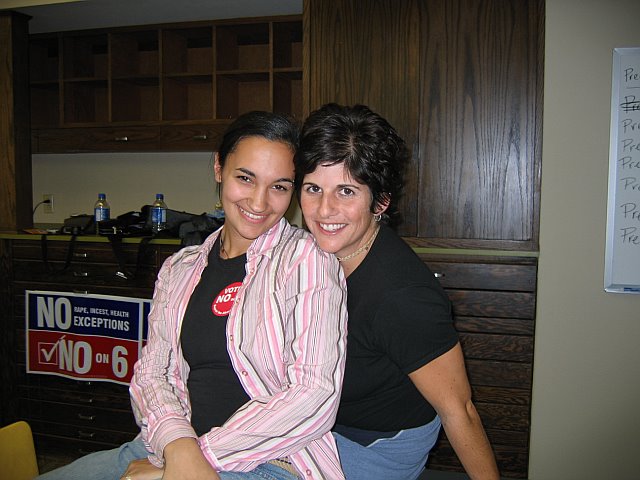
Jamia (from DC), Christine (native South Dakotan), and Gretchen (from New Haven, CT) - a few of the many incredible people working against Referred Law 6.
It was intense, and moving, and frightening, and life-changingly incredible. And, most importantly, WE WON (and yes, that is me in that picture, second from the left. score for me and Jamia, the two darkest people at the election night party in Sioux Falls. nothing like tokenism to gain you some fame.) I met incredible people, and I was actually doing things, things that mattered, instead of reading about doing things like I've done for the past 3 1/2 years while stuck in academia.
But there was something about the fight/success in South Dakota that never quite sat well with me.
South Dakota's demographics necessitated a strategy that I would not have chosen. SD is a red state. It helped George W get "elected" the first time around, and re-elected the second time. To make generalizations that are supported by polling numbers: they dislike gays (they were one of 7 states who passed the gay marriage bans this election), they don't like dark people (I was about as dark as tolerable, as was made perfectly clear while canvassing with Jamia, the only black person I saw in all of Brookings, where we were stationed most of the week), they don't particularly like women, and they're big on military and while they're split on the Iraq war, in the polls, most South Dakotans approve of it and the job Bushie is doing. In short, South Dakota isn't exactly the kind of bastion of liberalism (except in the traditional sense) that I would feel very comfortable in.
As a visual aid, there were a few of these scattered around the state in the days leading up to the election, with little resistance from South Dakotans.
The SDCHF and PPFA/PP of North Dakota-South Dakota-Minnesota conducted polls early on to give them information to shape their campaign strategy.
The strategy they shaped, then, was one that worked. But not necessarily one I was so ok with, given my conscience.
The approach we had to use was one that focused solely on the lack of exceptions provided in the law. The way it was written, the only exception to the full ban on all abortions exists for women whose lives would be in imminent danger if they were to go through with the pregnancy. There were no exceptions for if a woman's "mere" health were in danger, or for if a woman was the victim of rape or incest. This lack of exceptions, according to the polling that was done, was where the majority of South Dakotans felt the law went too far. And so, that was the part of the law that we attacked.
Our spiel (as I spoke it for between 8-12 hours per day, with the slight Midwest accent that I quickly picked up):
Hi, this is Jen, from the Campaign for Healthy Families. We're just calling [coming by] today to remind you how important it is to get out to vote on Tuesday, and specifically, how important it is to vote No on Referred Law 6. That's the abortion ban that has no exceptions for victims of rape or incest, or for if a woman's health is in danger. This election is going to be very close, so we wanted to make sure that everyone voting No on Referred Law 6 gets out to the polls this Tuesday. Polls will be open from 7am-7pm and you can cast your ballot at ____.
That was the GOTV spiel, not the Voter ID/Persuasion spiel, but the Voter ID/Persuasion spiel still spoke specifically about the lack of exceptions, said that the law "went too far." Still created all these ideological problems for me.
By focusing so intensely and specifically on the lack of exceptions, we were able to persuade voters to vote our way - by a 56%-44% margin, actually. (Still too close for comfort, but still a 12-point margin.)
However, by focusing so intensely and specifically on this lack of exceptions, we also reinforced the hierarchy of circumstances and stigmas surrounding the choice of abortion. That is, we didn't challenge - reinforced, actually - the idea that it's ok to have an abortion if your pregnancy is the result of incest or rape, or if your health or life is in danger, but for other reasons, it's not so ok. If your partner's condom broke? Tough shit. If the Pill just didn't work? Too bad - you shouldn't have been having consensual sex anyway, if you weren't willing to take on the consequences of such actions. It makes pregnancy into a punishment. It makes the right to an abortion contingent on how you got to the place where you need that choice.
Which is bullshit. Your control over your body doesn't decrease if your pregnancy was not the result of violence. Control over your body is control over your body. You can't qualify it.
But we had to, in order to win. If we'd gone in there with a message that my conscience would have been totally ok with, if we'd used the whole "my body, my choice" line, we would have easily had our asses handed to us and set up the overturning of Roe v Wade. We would have effectively lost the right to abortion for women throughout the country.
So we had to sacrifice our conscience, to a degree. We had to closet ourselves as "radical" pro-choicers who believe in the unqualified right to abortion and focus on qualifiers that were left out of the law.
We had to, in effect, strategize away our conscience for the good of the movement.
But when does it become ok to sacrifice the rights of some (in this case, women who were impregnated not through acts of violence or who didn't have life- or health-threatening pregnancies) in order to secure rights for others? When do these sacrifices become too much?
If you have to strategize away your conscience, how can you be ok with that strategy? If that's the only way you can get even minimal rights for women, does that make it ok? Is it worth it to put the rights of others aside to gain minimal basic rights for those that the majority will give rights to? Is strategic incrementalism really what the feminist movement should be embracing? Can we ignore the rights of some (even "temporarily") in favor of small gains for others (usually white, middle- or upper-class women)?
I know that as an activist, I'm not going to always be able to take the stands I feel comfortable taking because the situation is not always going to allow for it. I know that you can't be idealistic and pretend that the message you want to send will be warmly received in the majority of America. Because the fact remains that the majority of this country is not as pro-choice as I am. Doesn't believe that bodily integrity is a fundamental human right that should be extended to women. And while that's what we have to work toward changing, that's also what we have to work with.
In the comments on feministing recently, Amanda (of Pandagon said, wisely: "However, feminists have to work with the world we've got, not the one we want."
And I think I need to add to that. We have to work with what we've got, yes, but we also have to work toward what we want.
I wish more than anything that political strategy could work by being idealistic. By being all-inclusive all the time and by always employing good feminist, non-essentialist frameworks. And for a while, when I hadn't really left the liberal bastions of New York state and Northampton, Massachusetts, I thought that maybe it could. The people in my hometown, and especially the people here in Northampton, are actually pretty receptive to inclusive policy. But after being in Sioux Falls and Brookings, SD, and seeing "middle America," and actually finally experiencing people who may not think the way I do and may not have been raised the way I was...I've realized that can't happen. We can't have the perfect, all-inclusive strategy and actually be successful. We can work toward it, but we can't use it, not in the current political environment. Even with the huge gains the Dems, and women, and even queers (in AZ at least, kinda) made on November 7th this year, employing that kind of strategy would be asking to lose. Pushing the envelope is important. If you don't push the envelope, you don't get change. But over-pushing it causes severe backlash, and quite possibly sets you back further than you were when you started.
Something they don't teach you in school, even in women's studies or explicitly feminist academia, something incredibly disheartening:
In making and reading and analyzing theory, and even theorizing about political strategy, we can be inclusive and non-essentialist. We can be "good feminists."
But in strategizing and in political action, we can't be.
We've got to work toward the world we want, but we'll never get that world unless we work with the one we've got.
Tuesday, August 22, 2006
Sweet. Shopping Spree! For Free!

We all know that I'm all about promoting the gay agenda.
After all, I am gay. They send you the manual on Gay Proselytizing and Queerification Of America when you come out. It's pretty handy, really.
Oh, and I'm pro-choice, which means I'm a baby-killer too.
And I'm against the war, so I hate America.
And I'm for sex education, so I want 10-year-olds to be having sex.
But now I can do it for free! No more buying ice cream shakes for 10-year-old pre-gay kids (because, you know, queers are pedophiles too).
You, too, can take money from the wonderful people trying to save the world from baby-killing, pedophilic, anti-Americans like me.
The Stranger has an article up on how to get free stuff from Focus on the Family, "Dr." James Dobson's hate-mongering "Christian" group of evildoers.
I just screwed Focus on the Family and James Dobson out of $85!
"Bought" things such as "101 Frequently Asked Questions About Homosexuality" and "The Homosexual Agenda" (I should know what I'm promoting, after all).
And, of course, a lovely book called "The Feminist Mistake."
I should receive my items in about 7-10 days.
I can't wait.
*Note: This is not for people who are easily infuriated. Only those like me who can easily laugh off these assfaces should venture onto the site. If you have high blood pressure or a heart condition mixed with any sense of human decency, you should not visit Focus on the Family. If you are prone to high stress, you should also avoid the site.
Happy shopping!
------------------------------------------------------------------
And just in case FoF catches on and somehow makes The Stranger take down the article, I reproduce it in full here:
Shopping Spree
How to Get Free Books, CDs, and Movies from Focus on the Family—Thereby Taking Money out of the Pockets of Anti-Gay Bigots—in 12 Easy Steps
BY NOEL BLACK
Gay marriage is on the ropes and you may be feeling despondent about the tedious process and dim prospects for any kind of meaningful change in the near future. And why wouldn't you? There are a total of eight states in the U.S. that don't have Defense of Marriage amendments either on the books or in the works, and Massachusetts is still the only state that permits same-sex marriage. The Washington State Supreme Court handed down its anti-gay-marriage decision several weeks ago and Washington's gay community is licking its wounds and contemplating an incremental push for civil unions.
When I'm feeling despondent over the state of gay rights in America—or the concurrent assaults on reproductive freedom, science, and rational thought—there's just one thing that helps me overcome my feelings of despair: getting free shit from Focus on the Family!
Few people know that Focus on the Family—the powerful evangelical Christian para-church based in Colorado Springs—will give you, absolutely free of charge, books, CDs, and DVDs. Usually people pay for these products, and the millions of dollars raised helps Focus on the Family produce yet more books and CDs featuring Dr. James Dobson and other Focus "experts." (Focus on the Family's experts, when they're not chatting on the phone with Karl Rove, run around the country teaching people how to stop being so gay and when it's appropriate to kick their kids' asses.)
Not only does ordering free stuff from Focus on the Family—sent to myself or people I don't like—satisfy a deeply juvenile impulse, it has the added benefit of taking money directly out of homo-hater Dobson's pocket. The one drawback is that getting free shit from Focus on the Family is a tad time consuming and a bit tricky, but it's well worth the effort.
Here's how to do it:
1. Go to www.family.org and you will see their home page.
2. Once you're at the home page, look for the "Resources" link in the blue bar on the left-hand side, right above the "Search" box, and click it.
3. Under the "Resource Category" menu on the left-hand side, you'll notice categories such as "Homosexuality." Go ahead and click that for shits and giggles.
4. It's time to start shopping! Scroll down a little bit and feel the homophobia flow. How about a nice copy of A Parent's Guide to Preventing Homosexuality? Go ahead and click the "Add to Cart" button.
5. Now comes a tough decision: Do you have the book sent to yourself so you can sell it on eBay for cash (my personal favorite) or do you keep it on your mantel as a high-larious conversation piece to point at and laugh when your friends and family come over? Or do you send it to a jerk? I always opt for sending it to myself. Yes, you may end up on the Focus on the Family mailing list (though I've been doing this for some time and have never received anything beyond what I ordered), but reading Focus on the Family's junk mail is a good way to keep tabs on their activities and it will cost them even more money in postage.
Please note: Focus on the Family won't send you more than $100 worth of materials for free in any given shopping trip, so be sure to keep it reasonable and return often.
6. Select "Add New Shipping Address" and click "Proceed to Checkout." Or, hell, continue to shop and pick up a box set of The Chronicles of Narnia on CD.
7. The next screen will ask you to sign up for an account and give your information. Don't worry, they don't ask for your credit-card number. Enter whatever name and address you like, because you won't be paying. You might want to make up a phone number, too.
8. Once you've filled out all the required fields (you can also create a fake e-mail account if you're super paranoid), click "Proceed to Checkout" one more time. You'll now find yourself at the "Here Is Your Cart" field. Annoying thing alert: You may have to reenter your info again after this field to actually set up your account. But just keep going until you get to the "How Much Would You Like to Donate?" page.
9. So, how much would you like to donate? Zero dollars, obviously. Don't be fooled by the field in the lower-right-hand corner that shows you the suggested donation amounts. Simply select "Enter other total amount" and enter 0.00 as the amount you would like to pay. (Don't put in a dollar sign or it will ask you for credit-card information!) Proceed to checkout.
10. You'll now be led to a screen that will try to make you feel guilty about the amount you haven't donated. But don't feel bad! Just proceed to checkout again.
11. Jesus! Here you are on the twelfth step and you still don't have your self-hatred materials! And you thought preventing homosexuality was supposed to be easy! Click "Checkout Now" and you're done.
Congratulations!
You have just removed a few dollars from the coffers of a major anti-gay organization. You can further capitalize on your brief investment of time by selling the item/s on eBay. You'd be surprised how much money you can get—a friend of mine makes a few hundred extra dollars every few months on this perfectly legal activity.
And if your conscience begins to bother you, think of it this way: Focus on the Family would probably like for you to have the materials anyway, because there's that minute chance that, once in your hands, the materials may inspire you to have a personal relationship with Jesus.
Finally, don't forget to pass this information on to all your friends. Proselytizing isn't just for Christians, you know. Go gay!
Monday, July 31, 2006
thank god for feministe
Seems like victim-blamers aren't lacking in the feminist blogosphere either.
On the 28th, zuzu posted about a NJ woman who had been abducted, raped, and murdered when she and a friend went into New York City for some partying.
As per usual with threads about rape victims, the comments degenerated into a victim-blaming pissing match, with people talking about how "stupid" she was to have too much to drink and so on and so forth. One commenter actually said that the women were "basically hanging a “fuck with me” sign on their backs."
And today, zuzu called them out on it:
And sadly, this post also degenerated (though luckily not as quickly or as far) into some lovely victim-blaming, and whether saying that women need to report their rapes is victim-blaming or not (again, losing sight of the perpetrator).
I wrote about this too, about a month ago.
But I didn't quite get around to making this point that one of the commenters made on zuzu's post, which I reproduce in full here, because it captures the big picture very succinctly:
On the 28th, zuzu posted about a NJ woman who had been abducted, raped, and murdered when she and a friend went into New York City for some partying.
As per usual with threads about rape victims, the comments degenerated into a victim-blaming pissing match, with people talking about how "stupid" she was to have too much to drink and so on and so forth. One commenter actually said that the women were "basically hanging a “fuck with me” sign on their backs."
And today, zuzu called them out on it:
For once, just for once, I wanted to try to have a discussion about a woman getting raped and murdered that DIDN’T devolve into an extended rehash of the same goddamn argument we always seem to have whenever a rape and/or murder of a woman is discussed: Namely, we start out on topic, then someone has to come in and blame the victim (she was drunk! doesn’t she know there were consequences! she was dressed like a hoochie! she was a stripper! she must be lying! what was she doing alone at night? what was she doing trusting a man?) and we’re off to the races.
And inevitably, in all the talk about what the victim did or didn’t do and whether the natural consequence of having a few too many and making some poor parking decisions is to be abducted, raped, murdered and your body left in a dumpster, someone disappears.
And that person is the rapist/murderer.
And sadly, this post also degenerated (though luckily not as quickly or as far) into some lovely victim-blaming, and whether saying that women need to report their rapes is victim-blaming or not (again, losing sight of the perpetrator).
I wrote about this too, about a month ago.
But I didn't quite get around to making this point that one of the commenters made on zuzu's post, which I reproduce in full here, because it captures the big picture very succinctly:
We need to make him [the rapist] disappear to keep up the fiction that rapists are scary brown bogeymen who hide in dark alleys waiting to sate their uncontrollable lust for innocent white girls. They’re monsters, born bad, insane, hideous beasts. There’s nothing we can do to control them, so women must take responsibility for protecting ourselves.
If we keep up this fiction we can continue to pretend that men we know and trust can’t be rapists, too. We can continue to pretend that violent porn is “just a fantasy” and there’s no such thing as a “rape culture”.
Blaming women involves nothing more than decrying the rise in slutdom, which we’ve been doing for hundreds of years. Blaming men involves facing harsh truths about our culture, way of life, our sons and husbands and fathers. Blaming women is always easier.
on rape, disclosure, and relationships
I've been contemplating this post for a long time now, which of course means that things have become more, not less, convoluted. But let's see if I can make this somewhat coherent.
People talk a lot about the immediate damage that rape causes for the victim. You see it on TV shows (like my beloved Law & Order: SVU), you hear it talked about when the topic comes up in conversation (however rare that may be), and you read about it when news sources actually cover rape stories (again, a rarity).
You see the immediate effects: the tears, the pain, the complexities of the initial disclosure. Maybe you'll see or hear about these effects a month or two after. They have no qualms with showing that kind of damage. But past that, nothing. It's no longer worth covering or talking about when the pain isn't so fresh. But that, of course, doesn't mean that the pain is any less there.
I talked about this a little bit before, back in my post about the inaccuracy of the rhetoric of the "survivor" a few months back. About how you don't really "heal" or "get better."
I didn't really delve into how that inability to just "get past it" affects every other aspect of life, though.
Specifically, for the purposes of this post, how that plays into getting into/being in a relationship, and how that plays into intimate friendships.
I, personally, can't so much hide the fact that I've got...well, that I've got "a past." My left arm has about as much scar tissue as it has unscarred skin. (I'm right-handed, so my right arm is significantly clearer.) My upper thighs, too, are full of scars that scream "I'm fucked up." But the deal-breaker, it seems, is the scar on my upper stomach, right below my bra line. The scar that just puts it right out there. The scar spells out the word "SLUT."
That scar reveals, in no uncertain terms, that I've been hurt, and that I'm not exactly "healed." Even if someone who I was interested in could somehow get past the plethora of scars on the more easily noticeable parts of my body, that one would (and has) scare(d) them off. Because who wants to be with someone who was (for all they know, is) so unstable that she would brand herself as such?
Nobody.
At least, nobody who hasn't been through a similar situation herself. And even most of the people who have would rather be with someone "normal," not fucked up. (I know I would.)
And this is where things get tricky. Because once they've seen that scar, actual disclosure is somewhat unnecessary. Once they've seen that, they don't really want to know what it's about. And so you don't know how to have the "I was raped/abused/molested" conversation...since by that point, they've probably pretty well figured it out.
And of course, the point at which they figure it out is exactly the point when they decide that they don't want to deal with it. That you're too damaged for them to waste their time on anyway.
I know that sounds harsh. And I've had countless people tell me that I'm not "damaged goods," that I haven't actually ruined my chances of being in a relationship.
But really? It's kinda true.
I remember, when I was reading Lucky (by Alice Sebold), she wrote something about how, as a rape victim, you're perpetually alone. It makes you so different from every other "normal" person out there that people don't really know how to handle you, and they don't really want to.
I wish that weren't the case. I wish that rape didn't have such lasting effects.
But I also wish that people would recognize those effects. That they would actually acknowledge that the damage that rape causes doesn't end after a few months, after the victim "should" be "over it."
This isn't all coming out of nowhere. These are the things you think about when you start seeing (and shortly thereafter stop seeing) one of the lucky, sheltered women whose past is practically perfect. These are the things I've been reading, the things that have hit me pretty hard in the posts I've been reading in the couple past Carnivals Against Sexual Violence. Like the Triggers & Speaking Up post at lelyons. Because there's just something about triggers and relationships and the combination of the two that never seems to get much attention.
And in a way, I understand why it doesn't get that attention. Because really, who wants to talk about that? It's so much easier to pretend that there aren't implications years later, so much less disconcerting to ignore the long-lasting effects. But it's still a completely inaccurate portrayal of the reality.
Yes, I'm sure there are people out there who do well, great even, in relationships with women who have abusive pasts. Mostly, though, these are people who understand because they have similar pasts themselves.
The women I've dated and the women I will date who have practically perfect pasts will never be able to understand where I'm coming from in life. They'll never get why I'll cut away every so often while we're having sex, and they'll never get why I can't just automatically trust that they won't hurt me. Sure, they might say that they "understand," and they might think that they do...but unless you've gone through this yourself, it's not something you can ever fully comprehend.
I shouldn't have to try to explain this to people, though. I shouldn't have to only date people with similarly fucked up pasts just because the "normal" people won't understand. I shouldn't have to continue to deal with this, almost 8 years later.
And I know I do this a lot. I pull the "should" and "should not" thing, even though I know that "should/should not" really doesn't mean anything, and it's not something that I have any control over changing.
So to flip this into something a little more constructive, a little more plausible: I wish that people could comprehend just how deep the damage that rape causes goes. How long it lasts. How inescapable it is. Because even with all of this evidence, even with the huge numbers of victims, people still underestimate the damage and people still see it as a Not So Serious crime. And maybe that's because of our legal system that only recognizes it as such, or maybe it's because of the larger rape culture that surrounds us, but treating rape and sexual abuse as Not So Serious doesn't do anyone any favours...except, of course, the rapist.
People talk a lot about the immediate damage that rape causes for the victim. You see it on TV shows (like my beloved Law & Order: SVU), you hear it talked about when the topic comes up in conversation (however rare that may be), and you read about it when news sources actually cover rape stories (again, a rarity).
You see the immediate effects: the tears, the pain, the complexities of the initial disclosure. Maybe you'll see or hear about these effects a month or two after. They have no qualms with showing that kind of damage. But past that, nothing. It's no longer worth covering or talking about when the pain isn't so fresh. But that, of course, doesn't mean that the pain is any less there.
I talked about this a little bit before, back in my post about the inaccuracy of the rhetoric of the "survivor" a few months back. About how you don't really "heal" or "get better."
I didn't really delve into how that inability to just "get past it" affects every other aspect of life, though.
Specifically, for the purposes of this post, how that plays into getting into/being in a relationship, and how that plays into intimate friendships.
I, personally, can't so much hide the fact that I've got...well, that I've got "a past." My left arm has about as much scar tissue as it has unscarred skin. (I'm right-handed, so my right arm is significantly clearer.) My upper thighs, too, are full of scars that scream "I'm fucked up." But the deal-breaker, it seems, is the scar on my upper stomach, right below my bra line. The scar that just puts it right out there. The scar spells out the word "SLUT."
That scar reveals, in no uncertain terms, that I've been hurt, and that I'm not exactly "healed." Even if someone who I was interested in could somehow get past the plethora of scars on the more easily noticeable parts of my body, that one would (and has) scare(d) them off. Because who wants to be with someone who was (for all they know, is) so unstable that she would brand herself as such?
Nobody.
At least, nobody who hasn't been through a similar situation herself. And even most of the people who have would rather be with someone "normal," not fucked up. (I know I would.)
And this is where things get tricky. Because once they've seen that scar, actual disclosure is somewhat unnecessary. Once they've seen that, they don't really want to know what it's about. And so you don't know how to have the "I was raped/abused/molested" conversation...since by that point, they've probably pretty well figured it out.
And of course, the point at which they figure it out is exactly the point when they decide that they don't want to deal with it. That you're too damaged for them to waste their time on anyway.
I know that sounds harsh. And I've had countless people tell me that I'm not "damaged goods," that I haven't actually ruined my chances of being in a relationship.
But really? It's kinda true.
I remember, when I was reading Lucky (by Alice Sebold), she wrote something about how, as a rape victim, you're perpetually alone. It makes you so different from every other "normal" person out there that people don't really know how to handle you, and they don't really want to.
I wish that weren't the case. I wish that rape didn't have such lasting effects.
But I also wish that people would recognize those effects. That they would actually acknowledge that the damage that rape causes doesn't end after a few months, after the victim "should" be "over it."
This isn't all coming out of nowhere. These are the things you think about when you start seeing (and shortly thereafter stop seeing) one of the lucky, sheltered women whose past is practically perfect. These are the things I've been reading, the things that have hit me pretty hard in the posts I've been reading in the couple past Carnivals Against Sexual Violence. Like the Triggers & Speaking Up post at lelyons. Because there's just something about triggers and relationships and the combination of the two that never seems to get much attention.
And in a way, I understand why it doesn't get that attention. Because really, who wants to talk about that? It's so much easier to pretend that there aren't implications years later, so much less disconcerting to ignore the long-lasting effects. But it's still a completely inaccurate portrayal of the reality.
Yes, I'm sure there are people out there who do well, great even, in relationships with women who have abusive pasts. Mostly, though, these are people who understand because they have similar pasts themselves.
The women I've dated and the women I will date who have practically perfect pasts will never be able to understand where I'm coming from in life. They'll never get why I'll cut away every so often while we're having sex, and they'll never get why I can't just automatically trust that they won't hurt me. Sure, they might say that they "understand," and they might think that they do...but unless you've gone through this yourself, it's not something you can ever fully comprehend.
I shouldn't have to try to explain this to people, though. I shouldn't have to only date people with similarly fucked up pasts just because the "normal" people won't understand. I shouldn't have to continue to deal with this, almost 8 years later.
And I know I do this a lot. I pull the "should" and "should not" thing, even though I know that "should/should not" really doesn't mean anything, and it's not something that I have any control over changing.
So to flip this into something a little more constructive, a little more plausible: I wish that people could comprehend just how deep the damage that rape causes goes. How long it lasts. How inescapable it is. Because even with all of this evidence, even with the huge numbers of victims, people still underestimate the damage and people still see it as a Not So Serious crime. And maybe that's because of our legal system that only recognizes it as such, or maybe it's because of the larger rape culture that surrounds us, but treating rape and sexual abuse as Not So Serious doesn't do anyone any favours...except, of course, the rapist.
Friday, July 07, 2006
a million little carnivals
I've missed a ton during my hiaitus. Sorry 'bout that.
I'll try to go through and talk a little bit about a bunch of these, but for now, a handy little list of the more recent ones (in no particular order):
Similar to the blogging campaign I participated in a while back (Blog to Raise Awareness About Sexual Violence), Marcella has started what I guess is going to be a recurring carnival: the Carnival Against Sexual Violence. Number 1 is here, from June 1st. Number two is here, from July 1st.
Next one will go up on the 15th, and I'll link to it then.
And the carnival of feminists...well, I've missed a few, since the last one I blogged about was the 10th, and they're up to the 18th now.
So, links to the last couple:
Carnival of Feminists Number 18 at Ink and Incapability, up as of July 5th.
And the Seventeenth Carnival of Feminists at Bitch|Lab, published on June 21st.
And then there are The Gays with their damn Homosexual Agenda(tm) at the Carnival of Bent Attractions. The couple most recent ones:
The Seventh Carnival of Bent Attractions at 2sides2ron, up on June 10th.
And the Sixth Carnival of Bent Attractions at Multidimensional.Me, up on May 10th.
And lastly, the Radical Women of Color Carnival. I've missed a bunch of these, too, so the last couple:
The Fifth Radical Women of Colo(u)r Carnival at Fabulosa Mujer, up on June 6th.
And the Fourth Radical Women of Colo(u)r Carnival at blac(k)ademic, up as of May 6th.
I'll try to go through and talk a little bit about a bunch of these, but for now, a handy little list of the more recent ones (in no particular order):
Similar to the blogging campaign I participated in a while back (Blog to Raise Awareness About Sexual Violence), Marcella has started what I guess is going to be a recurring carnival: the Carnival Against Sexual Violence. Number 1 is here, from June 1st. Number two is here, from July 1st.
Next one will go up on the 15th, and I'll link to it then.
And the carnival of feminists...well, I've missed a few, since the last one I blogged about was the 10th, and they're up to the 18th now.
So, links to the last couple:
Carnival of Feminists Number 18 at Ink and Incapability, up as of July 5th.
And the Seventeenth Carnival of Feminists at Bitch|Lab, published on June 21st.
And then there are The Gays with their damn Homosexual Agenda(tm) at the Carnival of Bent Attractions. The couple most recent ones:
The Seventh Carnival of Bent Attractions at 2sides2ron, up on June 10th.
And the Sixth Carnival of Bent Attractions at Multidimensional.Me, up on May 10th.
And lastly, the Radical Women of Color Carnival. I've missed a bunch of these, too, so the last couple:
The Fifth Radical Women of Colo(u)r Carnival at Fabulosa Mujer, up on June 6th.
And the Fourth Radical Women of Colo(u)r Carnival at blac(k)ademic, up as of May 6th.
Thursday, June 22, 2006
On Rape and "Precautions"
This is something that has come up over and over again on the forum on Smith's Jolt, and while my stand on it still isn't completely clear, I feel like it's something I should blog about, because it's something that causes some factioning within the feminist community.*
The issue is rape. And what responsibility women should take for their actions or what precautions she should take. (The "rape threads" on the forum at the Jolt have become kind of dreaded because of this incessant, seemingly unresolvable argument.)
The argument usually goes something like this:
1. Someone posts something vaguely related to rape. (Most recently, it stemmed from a post on the recent WaPo article claiming that rape rates have drastically declined in the past few decades.)
2. Someone replies and brings up the problem with rape prevention based solely or mostly on "teaching women to avoid unsafe situations." (Ok, I'll admit, this time, it was me.)
3. Number 2 inevitably opens up the can of worms, with an equal number of people arguing either that taking precautions is simply logical or that creating a prevention strategy based on women's actions is victim-blaming.
4. The thread eventually devolves into what is pretty typical of the Jolt, with people arguing ineffectively and making no logical point whatsoever. It starts to become an O'Reilly-Factor-style argument, at which point the people seriously trying to argue the point just sit back and watch the stupidity take away their credibility.
It seems that I always get pulled into these arguments, because some of the things people say under the anonymity of the Jolt make me so angry that I can't just stay quiet (some say it's an endearing quality...but sometimes, I fear that I'm going to have a heart attack from the stress by the time I'm 27).
Thing is, I can never make my point eloquently or succinctly enough on the Jolt to make a difference, so I'm going to try to do so here.
What started all of this recently was this line in the article, attempting to explain the reason for the supposed 85% drop in rapes since the 1970s:
The whole sentence is just a little inaccurate, and I could devote an entire blog post to that sentence. But the thing that bothered me the most was the bolded part of the sentence: "Women have been taught to avoid unsafe situations."
In a nutshell, my issue with this is as follows: It is not a woman's job to decrease sexual assaults perpetrated against her.
Now, of course, that is highly oversimplified, and needs expanding.
In theory (if one were to subscribe wholly to the rape culture ideology), it would make sense to not put yourself into a situation where a crime is "likely" to occur.
But that theory itself is inherently flawed, and has very few practical implications.
For one, the majority of rapes are acquaintance rapes, not stranger rapes. These "precautions" (not going out alone after dark and so on) are only even theoretically applicable in stranger-rape scenarios. Not going to help you if you're going out after dark with the person you're trusting to accompany you after dark to protect you from the man waiting in the bushes to rape you, the person who ends up being your rapist.
And then, of course, there's the issue of undue, burdensome limitations on women's mobility. If you can't go out alone, but you have nobody to accompany you, you just can't go out. So much for empowering women. "Ending" and "preventing" rape isn't really going to do much for women's upward mobility if women have to worry about who they're doing what with every second of the day (or, at least, every second of the night).
The argument that continually comes up is the analogy to a mugging. You don't go down a city street that you know to be prone to muggers with a wad of bills in plain sight. So, logically, you would not go into a bar by yourself, flash some guy, and expect not to get raped. Same thing, right?
Except...it's so not.
Mugging and rape are not comparable crimes.
That seems like such an obvious statement, but apparently, it's, um, not.
Even if you were to talk strictly about stranger rapes, these "precautions" that women are supposed to take are, I would argue, nothing more than victim-blaming techniques dressed up as "protecting women."
You can have the best intentions when telling a woman to make sure she doesn't walk home alone at night, but what are you going to say when that woman doesn't heed your well-intentioned advice and is raped as she's walking home alone? It is very straight logic to go from "You shouldn't walk home alone," to "Well, I told you to not to walk home alone."
The latter, of course, is telling the woman that she put herself in that situation, and is therefore at least partially accountable and responsible for the actions that resulted from her "allowing" that situation to arise.
a.k.a. Blaming the victim.
Unfailingly, the pro-"precaution" crowd then argues that of course the man is culpable...but (and here comes the victim-blaming) she should have been more careful.
Or, even better, "Well, now you know not to walk home alone." Or "Bet you won't get that drunk in mixed company again, eh?"
The latter two are very thinly veiled examples of the victim-blaming, but they are all cut from the same cloth. All rely on using the victim's lack of "precautions" to not only blame the victim (non-maliciously, for the most part) but to make themselves feel better about their own actions; specifically, to make themselves feel safer, like they do enough to make sure they won't "get themselves raped" like Susie over there.
And going back to the mugging example...rape, given the reliance on it to uphold the patriarchal culture and the gender/power element, is simply an inherently different crime. Mugging undoubtedly has socio-economic undertones, but rape has centuries and centuries of gender oppression built into it. So much so that people don't even question the basis of it anymore, which is where the biggest problem with this "precaution" prevention line of reasoning comes in.
Saying that women should take precautions because of the hostile, dangerous environment does nothing to question or undermine that hostile, dangerous environment in the first place.
And rape is not going to end until said hostile, dangerous environment is obliterated.
The man's responsibility and motive - especially their motive - is almost never questioned. Rape, for men (as perpetrators), is highly eroticized -- obviously, they're doing it to get their rocks off. Or something like that. The question of power or motive is never addressed. This assumed motive -- that they're doing it because they "can't help it," because they need the sexual release -- simply plays into the perpetuation of the threat and culture of rape. If you assume that men do it because they have to, then rape is inevitable, and nothing but women taking (often ineffective) immobilizing precautions even has a chance of decreasing the numbers.
So yes, in theory, given the current dominant ideology, telling women to limit their lives according to precautions will decrease the rape rates.
But how is anything going to change if you base all of your theories on the current
dominant ideology?
----------------------------------------------------
*NOTE: This piece deals specifically with male-perpetrator female-victim rapes. Of course, there are instances where women rape other women, men rape other men, women rape men, and everything in between and above and beyond. The most prevalent, however, is male-perpetrator female-victim rapes, and the gender dynamics and social implications of other instances of rapes are far too complex to delve into here.
The issue is rape. And what responsibility women should take for their actions or what precautions she should take. (The "rape threads" on the forum at the Jolt have become kind of dreaded because of this incessant, seemingly unresolvable argument.)
The argument usually goes something like this:
1. Someone posts something vaguely related to rape. (Most recently, it stemmed from a post on the recent WaPo article claiming that rape rates have drastically declined in the past few decades.)
2. Someone replies and brings up the problem with rape prevention based solely or mostly on "teaching women to avoid unsafe situations." (Ok, I'll admit, this time, it was me.)
3. Number 2 inevitably opens up the can of worms, with an equal number of people arguing either that taking precautions is simply logical or that creating a prevention strategy based on women's actions is victim-blaming.
4. The thread eventually devolves into what is pretty typical of the Jolt, with people arguing ineffectively and making no logical point whatsoever. It starts to become an O'Reilly-Factor-style argument, at which point the people seriously trying to argue the point just sit back and watch the stupidity take away their credibility.
It seems that I always get pulled into these arguments, because some of the things people say under the anonymity of the Jolt make me so angry that I can't just stay quiet (some say it's an endearing quality...but sometimes, I fear that I'm going to have a heart attack from the stress by the time I'm 27).
Thing is, I can never make my point eloquently or succinctly enough on the Jolt to make a difference, so I'm going to try to do so here.
What started all of this recently was this line in the article, attempting to explain the reason for the supposed 85% drop in rapes since the 1970s:
Another, more hopeful, explanation is that Americans have actually changed the way they think about sexual assault: Women have been taught to avoid unsafe situations, and both boys and girls have been drilled to understand the rules of consent. (emphasis mine)
The whole sentence is just a little inaccurate, and I could devote an entire blog post to that sentence. But the thing that bothered me the most was the bolded part of the sentence: "Women have been taught to avoid unsafe situations."
In a nutshell, my issue with this is as follows: It is not a woman's job to decrease sexual assaults perpetrated against her.
Now, of course, that is highly oversimplified, and needs expanding.
In theory (if one were to subscribe wholly to the rape culture ideology), it would make sense to not put yourself into a situation where a crime is "likely" to occur.
But that theory itself is inherently flawed, and has very few practical implications.
For one, the majority of rapes are acquaintance rapes, not stranger rapes. These "precautions" (not going out alone after dark and so on) are only even theoretically applicable in stranger-rape scenarios. Not going to help you if you're going out after dark with the person you're trusting to accompany you after dark to protect you from the man waiting in the bushes to rape you, the person who ends up being your rapist.
And then, of course, there's the issue of undue, burdensome limitations on women's mobility. If you can't go out alone, but you have nobody to accompany you, you just can't go out. So much for empowering women. "Ending" and "preventing" rape isn't really going to do much for women's upward mobility if women have to worry about who they're doing what with every second of the day (or, at least, every second of the night).
The argument that continually comes up is the analogy to a mugging. You don't go down a city street that you know to be prone to muggers with a wad of bills in plain sight. So, logically, you would not go into a bar by yourself, flash some guy, and expect not to get raped. Same thing, right?
Except...it's so not.
Mugging and rape are not comparable crimes.
That seems like such an obvious statement, but apparently, it's, um, not.
Even if you were to talk strictly about stranger rapes, these "precautions" that women are supposed to take are, I would argue, nothing more than victim-blaming techniques dressed up as "protecting women."
You can have the best intentions when telling a woman to make sure she doesn't walk home alone at night, but what are you going to say when that woman doesn't heed your well-intentioned advice and is raped as she's walking home alone? It is very straight logic to go from "You shouldn't walk home alone," to "Well, I told you to not to walk home alone."
The latter, of course, is telling the woman that she put herself in that situation, and is therefore at least partially accountable and responsible for the actions that resulted from her "allowing" that situation to arise.
a.k.a. Blaming the victim.
Unfailingly, the pro-"precaution" crowd then argues that of course the man is culpable...but (and here comes the victim-blaming) she should have been more careful.
Or, even better, "Well, now you know not to walk home alone." Or "Bet you won't get that drunk in mixed company again, eh?"
The latter two are very thinly veiled examples of the victim-blaming, but they are all cut from the same cloth. All rely on using the victim's lack of "precautions" to not only blame the victim (non-maliciously, for the most part) but to make themselves feel better about their own actions; specifically, to make themselves feel safer, like they do enough to make sure they won't "get themselves raped" like Susie over there.
And going back to the mugging example...rape, given the reliance on it to uphold the patriarchal culture and the gender/power element, is simply an inherently different crime. Mugging undoubtedly has socio-economic undertones, but rape has centuries and centuries of gender oppression built into it. So much so that people don't even question the basis of it anymore, which is where the biggest problem with this "precaution" prevention line of reasoning comes in.
Saying that women should take precautions because of the hostile, dangerous environment does nothing to question or undermine that hostile, dangerous environment in the first place.
And rape is not going to end until said hostile, dangerous environment is obliterated.
The man's responsibility and motive - especially their motive - is almost never questioned. Rape, for men (as perpetrators), is highly eroticized -- obviously, they're doing it to get their rocks off. Or something like that. The question of power or motive is never addressed. This assumed motive -- that they're doing it because they "can't help it," because they need the sexual release -- simply plays into the perpetuation of the threat and culture of rape. If you assume that men do it because they have to, then rape is inevitable, and nothing but women taking (often ineffective) immobilizing precautions even has a chance of decreasing the numbers.
So yes, in theory, given the current dominant ideology, telling women to limit their lives according to precautions will decrease the rape rates.
But how is anything going to change if you base all of your theories on the current
dominant ideology?
----------------------------------------------------
*NOTE: This piece deals specifically with male-perpetrator female-victim rapes. Of course, there are instances where women rape other women, men rape other men, women rape men, and everything in between and above and beyond. The most prevalent, however, is male-perpetrator female-victim rapes, and the gender dynamics and social implications of other instances of rapes are far too complex to delve into here.
Subscribe to:
Posts (Atom)